
About these answers
The guidance asks a bank to weigh fourteen things about a third party before relying on it, and to keep weighing them while the relationship lasts. The sections below take the factors in the order the agencies list them. Each gives the factor’s name, the question it asks in plain English, and what is true of FloodCaliber™ and of Sixth Wave Solutions as of November 23, 2026.
Items that depend on your contract or on a signed non-disclosure agreement, such as financial information, insurance certificates and audit rights, are provided on request. Ask through the demo form and say the request is for vendor management.
Credit unions: the NCUA did not join the 2023 guidance; its framework is still Letter to Credit Unions 07-CU-13. The same answers apply.
Factor 1. Strategies and goals
What it asks. Does the third party’s business fit the activity the bank wants it for?
FloodCaliber™ does one thing: it keeps a lender’s flood insurance compliance position current for its whole loan portfolio, links every figure to the document it came from, and sends a person only the loans where something disagrees. It does not sell insurance, make flood determinations or place insurance.
Factor 2. Legal and regulatory compliance
What it asks. Does the third party understand the rules the activity is under?
Every result names the paragraph it rests on: 12 CFR 339 for the FDIC and its parallels at the OCC (part 22), the Federal Reserve (208.25), the NCUA (part 760) and the Farm Credit Administration (part 614, subpart S), the statute, and the 2022 Interagency Questions and Answers. The texts are kept in the product as retrieved, with their dates, and compared with the current eCFR and U.S. Code on request.
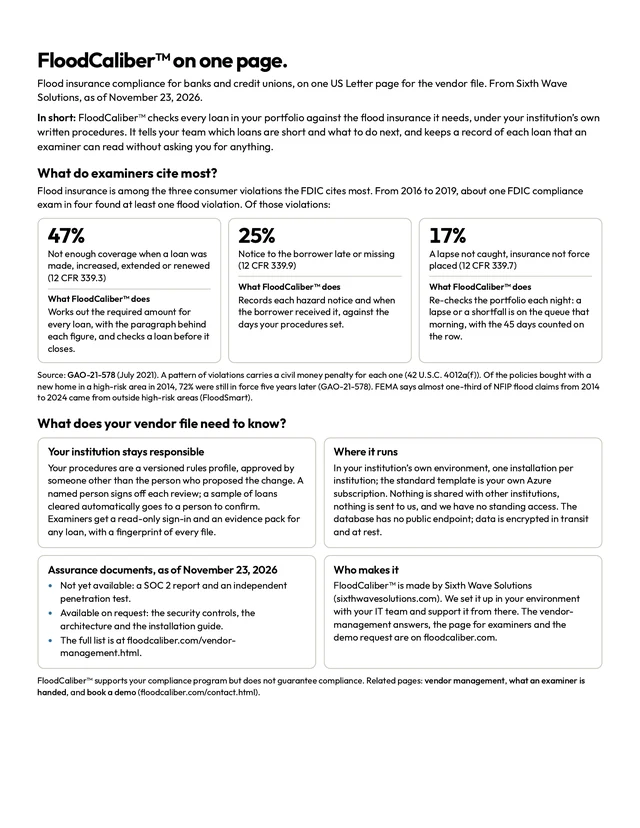
Your institution remains responsible for its flood compliance. FloodCaliber™ is built so that a named person signs off each review, a second person signs off any review where the first changed the loan, and a share of the loans cleared automatically goes to a person to confirm.
Factor 3. Financial condition
What it asks. Can the third party keep providing the service?
FloodCaliber™ runs in your institution’s own environment. If we stopped supporting it, the installation, its data and its records would stay where they are, in your control.
Financial information, and the terms it is shared under, are provided on request through the demo form.
Factor 4. Business experience
What it asks. How long has the third party done this, and for whom?
FloodCaliber™ is a new product from Sixth Wave Solutions. References and the company’s history are provided on request through the demo form.
Factor 5. Key personnel
What it asks. Who will do the work, and what do they know?
The names and backgrounds of the people who set up and support an installation are provided on request through the demo form.
Factor 6. Risk management
What it asks. How does the third party control the quality of what it delivers?
- A pure, deterministic calculation engine. Whole cents, no network, no clock, no randomness, and every result traced to a citation. A check on every change keeps it that way.
- Automated tests on every change. On October 30, 2026, the suites held 456 tests of the rules engine, 733 of the server, 70 of the screens and 51 browser walk-throughs, one per role, with accessibility checks.
- Your procedures as a versioned rules profile. A change is drafted, approved by someone other than the person who sent it, and takes effect on a date. Each loan’s record names the version it was checked under.
- A document never changes a loan on its own. A person accepts each figure read from a document, and the choice and the person are recorded.
Factor 7. Information security
What it asks. How is the bank’s information protected? The guidance names SOC reports and penetration tests.
- One installation per institution. In the standard template, in the institution’s own Azure subscription and Microsoft Entra tenant. Nothing is shared with other institutions and nothing is sent to us. We have no standing access.
- No public database. The database has no public endpoint. Document storage, the key vault and the document reader sit behind private endpoints with public access off. The only public address is the application, over HTTPS.
- Encryption. TLS 1.2 or later in transit; AES-256 at rest with Microsoft-managed keys, and double encryption on storage in production. Customer-managed keys are not in the standard template; they can be added.
- Sign-in. Microsoft Entra ID, or passwords (at least 12 characters, hashed with scrypt, locked after five failures) with a second step from an authenticator app, required by default. Sessions end after 12 hours idle.
- No shared secrets between services. Services sign in with a managed identity; storage has no account keys at all. Remaining secrets live only in Key Vault.
- Uploads checked by content, not name. PDFs with scripts, and archives that unpack to more than 100 times their size, are refused.
- Source control. Every commit is scanned for secrets, and dependency updates are proposed weekly.
Not yet available: a SOC 2 report and an independent penetration test. See assurance documents for what is available instead.
Factor 8. Management of information systems
What it asks. Can the third party show what happened, and when?
- A chained history of every decision. What was decided, by whom, on what evidence, is written to a history in which each entry is chained to the one before it, so a change after the fact shows. The application verifies the chain.
- An access log. Who viewed or downloaded which loan, document or export is logged the same way, and examiners can read it.
- One place for logs. Application, platform, database, storage and key vault logs go to one Log Analytics workspace in your subscription, kept 365 days. Borrower names, document text and secrets are removed before anything is logged.
Factor 9. Operational resilience
What it asks. How fast can the service and its data come back? The guidance asks for the time frame.
- Backups. Database: point-in-time restore for 35 days. Documents: versioning and soft delete for 30 days, and a document is never changed in place. Key Vault: 90 days with purge protection.
- A written restore drill. Step by step, to be run before going live and every quarter, with the date, the restore point and the time taken kept for examiners.
- The target. A recovery point of minutes and a recovery time of an hour or two. The first drill at your institution gives the figures for your file.
- Releases. A new release rolls out while the previous one keeps serving until the new one is healthy; a rollback is one command.
Factor 10. Incident reporting
What it asks. Will the third party tell the bank about an incident, and how quickly?
Because FloodCaliber™ runs in your environment, its logs and alerts are yours first. The standard template does not include alert rules; we recommend alerts on key vault access failures, database load and server errors, connected to your SIEM.
Our notification commitment for incidents we learn of, and its time frame, are set out in the contract and provided on request through the demo form.
Factor 11. Physical security
What it asks. Where is the equipment, and who can reach it?
In the data centers of your institution’s own cloud, in the region you choose; in the standard template, Microsoft’s Azure data centers. Sixth Wave Solutions holds none of your data on its own premises or devices.
Factor 12. Reliance on subcontractors
What it asks. Who else touches the bank’s information?
Microsoft Azure, for hosting and, in the standard template, for reading documents (Azure Document Intelligence, in your subscription and region). Microsoft states that Document Intelligence does not use customer data to train models; confirm against its current terms for your region. Where your institution chooses another approved document reader, it runs under your own agreement with that provider.
Only if you switch them on: the flood map watch sends each building’s address to the U.S. Census Bureau to place it on the map, and the map point to FEMA’s public flood map; the community lookup sends community numbers to FEMA. No names, amounts or documents go to either.
Factor 13. Insurance coverage
What it asks. Does the third party carry insurance that would cover a loss it caused?
Certificates of our cyber and errors-and-omissions coverage are provided on request through the demo form.
Factor 14. Contractual arrangements with other parties
What it asks. What happens to the bank’s data at the end, and can regulators get access?
At the end of the contract you export the loan records and the portfolio workbook, then delete the resource group. The data never left your environment, so there is nothing for us to return.
Examiners get their own read-only sign-in to your installation, with the access log. What an examiner is handed describes it.
Contract terms for your right to audit and for regulators’ access to us are provided on request through the demo form.