The Flood Compliance Manual for Lenders
- A free PDF with your work email
- Current as of November 2026
- For flood, servicing and compliance teams at banks and credit unions

The Flood Compliance Manual for Lenders
Current as of November 2026
What’s inside
- 15 chapters, each also a free guide
- Checklists and an agency citation table
- Worked examples on fictional loan files
In short: The federal flood insurance rules a lender has to follow, in one manual, written by our team in plain language. Fifteen chapters take you from the first determination to the exam, with checklists, an agency citation table and worked examples on fictional loan files.
Get the manual
To get the manual, email hello@floodcaliber.com and our team will send you a copy.
Every chapter is also free to read now as a flood compliance guide.
Thanks, we’ve got your request.
We’ve emailed a download link to . It works for 7 days. If it isn’t there in a few minutes, check your spam folder.
Dry run. Email is off on this copy of the site, so nothing was sent. Download the manual (the link works for 7 days)
What’s inside
- chapters, each also a free guide
- 15
- appendices
- 4
- regulators in the citation table
- 5
All 15 chapters Each one is also a free guide you can read online now
-
Flood insurance requirements for lenders
Every requirement in one place, from the determination to penalties, with the OCC, Federal Reserve, FDIC, NCUA and Farm Credit Administration citations side by side.
Free guide: Flood insurance requirements for lenders
-
Make, increase, renew, extend
The four events that trigger the requirement, the loan events that don’t, and what has to happen at each one.
Free guide: Make, increase, renew, extend
-
Flood zone determinations and the SFHDF
When a determination is required, what the Standard Flood Hazard Determination Form must contain, the seven-year reuse rule, fees and zone disputes.
Free guide: Flood zone determinations and the SFHDF
-
The notice of special flood hazards
Who gets the notice and when, what it must say and the record of receipt.
Free guide: The notice of special flood hazards
-
How much coverage, by building
The required amount, building by building: the loan balance, NFIP limits, insurable value and contents, with two worked examples.
Free guide: How much coverage, by building
-
Exemptions and detached structures
What counts as a building, the only three exemptions, and the tests for detached garages, barns and sheds.
Free guide: Exemptions and detached structures
-
Condominium loans and the RCBAP
A unit loan’s required amount, crediting the association’s RCBAP, supplemental coverage, lapses and co-ops.
Free guide: Condominium loans and the RCBAP
-
Construction loans
When a construction loan needs coverage, deferring it until before funds go out for building construction (the slab and preliminary site work excepted), and the NFIP’s 30-day waiting period.
Free guide: Construction loans
-
Private flood acceptance
When a lender must accept a private flood policy, when it may, what the compliance aid statement does, and how to document the decision.
Free guide: Private flood acceptance
-
Escrow and its exceptions
When premiums must be escrowed, the loan exceptions, the small lender exception and the notices.
Free guide: Escrow and its exceptions
-
Force placement and the 45 days
The notice to the borrower, buying coverage when 45 days pass without it, and refunding the overlap within 30 days of proof.
Free guide: Force placement and the 45 days
-
Map changes
What to do when a building is remapped into or out of a special flood hazard area, zone disputes, and reusing an earlier determination.
Free guide: Map changes
-
SBA loans
SBA’s rule under 13 CFR 120.170, which follows the loan proceeds, alongside the bank rules, which follow the collateral.
Free guide: SBA loans
-
Civil money penalties
The violations that carry mandatory penalties, the per-violation maximum, how regulators judge a pattern or practice, and what the public orders show.
Free guide: Civil money penalties
-
The Interagency Questions and Answers
All 19 sections of the 2022 Q&As, mapped to the chapter that covers each.
Free guide: The Interagency Questions and Answers
The four appendices
A citation table for all five regulators, checklists, the worked examples on fictional loan files, and a glossary.
Who it’s for
The teams at banks and credit unions who answer for flood compliance: flood teams who review loan files, servicing teams who track policies and force-place coverage, and compliance teams who test the program and sit with the examiners. Each chapter says what the rule requires, which agency wrote it and what to keep on file to show you followed it.
General information, not legal advice. The manual summarizes federal rules and agency guidance as our team reads them, current as of November 2026. State law, investor requirements and your loan contracts can add to them, so confirm your procedures with your counsel.
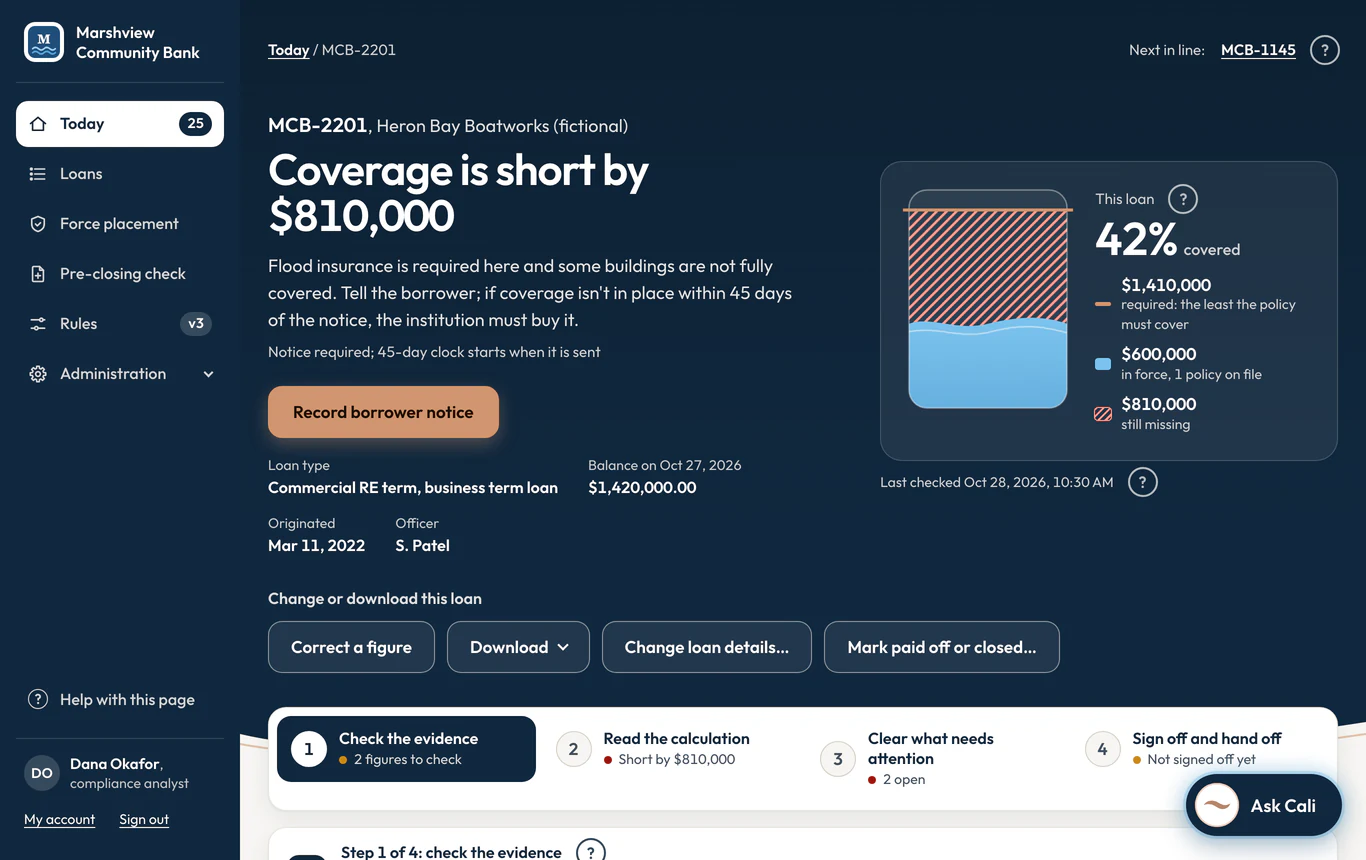
The manual tells you what the rules require. FloodCaliber™ does the work across your loan files.
FloodCaliber™ catches every lapse, works out the exact amount building by building, prepares the notice and builds the exam record, inside your environment, with every number tied to its page.
- The required amount. Worked from your loan files, building by building, with contents where they secure the loan.
- Force placement. From the lapse to the notice, the 45 days and the refund, in one workflow.
- The exam record. Every figure linked to its source page, with the rule versions your examiners ask about.
Our team works with your flood, servicing and compliance staff as a partner in flood compliance.
FloodCaliber™ supports your compliance program but does not guarantee compliance. It doesn’t sell or place insurance.