
The key points
If you find, at any time during the loan, that a building securing a designated loan has no flood insurance or less than the required amount:
- Notify the borrower when you make that determination.
- Buy the coverage on the borrower’s behalf if they haven’t bought it within 45 days after notification. You may place it sooner, and you may charge them for it back to the date the coverage lapsed or fell short.
- Cancel and refund within 30 days of receiving proof of the borrower’s own coverage: tell the insurer to cancel the placed policy, and refund the premiums and fees for any overlap.
A designated loan is one secured by a building or mobile home located, or to be located, in a special flood hazard area (SFHA) where flood insurance is available under the National Flood Insurance Program (NFIP). A few exemptions apply, such as a detached structure on residential property that isn’t used as a residence, and a loan with an original principal balance of $5,000 or less and a repayment term of one year or less (12 CFR 22.4). The five federal regulators that write flood rules use the same wording, so the sequence is the same at a national bank, a state bank, a credit union or a Farm Credit institution.
The steps, in order
Each step below cites the OCC’s rule, 12 CFR 22.7; the other regulators’ rules say the same thing (see each regulator’s rule). “Q&A” references are to the regulators’ 2022 Interagency Questions and Answers Regarding Flood Insurance.
-
Find the gap
Day 0: the determinationThe duty starts when you, or a servicer acting for you, determine that the building or mobile home, and any personal property securing the loan, isn’t covered by flood insurance or is covered for less than the required amount. The rule applies “at any time during the term of a designated loan,” not only at closing. Gaps usually show up when:
- a policy lapses or isn’t renewed;
- a review finds coverage below the required amount, often on one building of a multi-building commercial loan;
- a FEMA map change brings the building into an SFHA. The loan becomes a designated loan on the map change’s effective date, so that’s the date to check coverage (Q&A Force Placement 16).
The required amount is at least the lesser of the outstanding principal balance and the maximum coverage available for that type of property (12 CFR 22.3(a)). The Q&As read that maximum as the lower of the NFIP limit for the building type and the building’s insurable value, since flood insurance doesn’t cover land. With several buildings in an SFHA, work out the coverage available for each nonexempt building securing the loan, its NFIP limit capped at its insurable value, and add those up. The total required is the lesser of that sum and the outstanding principal balance, and it can be spread across the buildings in varying amounts as long as each nonexempt building is covered (Q&A Amount 1, Q&A Amount 5 and Q&A Amount 6).
The rules don’t say how to find gaps. The Q&As note that there’s no explicit duty to monitor coverage over the life of the loan, but many lenders do, because it helps them place coverage on time (Q&A Force Placement 15).
 With FloodCaliber™: a lapse, a shortfall or a flood-zone change is flagged on the loan and on the portfolio dashboard, and the required amount is worked from your loan files building by building, with each value linked to its page.
-
Notify the borrower
Day 0: send the noticeTell the borrower to obtain flood insurance, at the borrower’s expense, in at least the required amount, for the remaining term of the loan. The regulators expect the notice to go out when you make the determination; if there’s a brief delay, for example from batch processing, be ready to give a reasonable explanation (Q&A Force Placement 2).
A courtesy letter before a policy expires is fine, but it doesn’t replace the notice: you still have to notify the borrower once the policy has actually lapsed or proved insufficient (Q&A Force Placement 4). Keep a record of the date you notified the borrower, because the 45 days run from it. What the notice should say is covered below.
With FloodCaliber™: the notice is prepared with the required amount for each building, ready to send, and the notification date starts the 45-day countdown. -
The 45 days
Days 1 to 45The borrower has 45 days after notification to obtain the coverage. You may place coverage sooner (see the next step), but the deadline doesn’t move, and the clock doesn’t restart: you can’t make a second determination and send a second notice to give the borrower more time, and a borrower who buys too little coverage in response doesn’t get an extension (Q&A Force Placement 6).
Proof that arrives during the 45 days still has to be checked: the right amount for each building, and, for a private policy, your acceptance rules. A policy that falls short leaves a smaller gap, not a new clock.
With FloodCaliber™: each open case counts down from the confirmed notice date on the dashboard, and proof that arrives, NFIP or private, is read and checked against the required amount. -
Force-place the coverage
By day 45If the borrower hasn’t obtained the coverage within 45 days after notification, you or your servicer must purchase it on the borrower’s behalf. If placement slips briefly past day 45, the regulators expect a reasonable explanation (Q&A Force Placement 5).
- How much. Place the full required amount or, if the borrower has a policy that’s otherwise acceptable but too small, only the difference (Q&A Force Placement 1). If the required amount is based on the principal balance and you’ll capitalize the premium and any related fees into it, size the policy to the higher balance: on a $200,000 balance (insurable value $350,000) with a $2,000 premium and no other capitalized fees, at least $202,000, since the requirement is still capped at the most coverage available (Q&A Force Placement 8).
- When. You don’t have to wait the full 45 days. You may force-place and charge the borrower from the date coverage lapsed or fell short, but only for a policy that actually provides coverage from that date (Q&A Force Placement 9).
- No double charge. The placed policy can start when the old one expires, at 12:01 a.m. the same day, and the borrower shouldn’t be charged for any period of overlapping coverage (Q&A Force Placement 7).
With FloodCaliber™: if adequate proof hasn’t arrived, the case is ready on day 45: the amount to place and the evidence behind it, sent to your tracking system or insurer through a connection your team approves. -
Cancel and refund within 30 days
Within 30 days of proofWithin 30 days of receiving confirmation of the borrower’s existing flood coverage, you or your servicer must notify the insurer to terminate the placed policy and refund the premiums the borrower paid for any period when both policies were in effect, plus any related fees charged for that period (12 CFR 22.7(b)(1)).
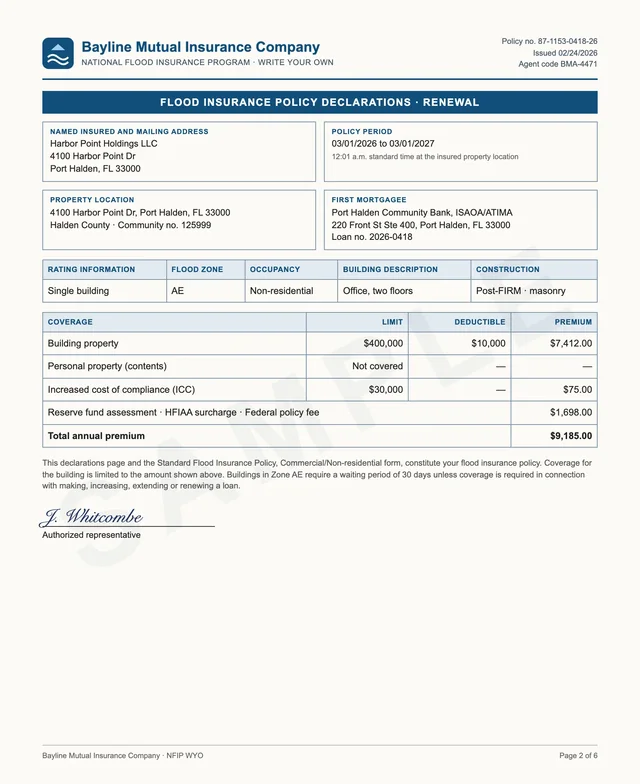
You must accept a declarations page as confirmation if it includes the existing policy number and the identity of, and contact information for, the insurance company or agent (12 CFR 22.7(b)(2)). The 30 days apply even if the insurer hasn’t refunded you yet (Q&A Force Placement 12).
With FloodCaliber™: when proof arrives after placement, the overlap is flagged so your team can cancel the placed policy and refund within 30 days, with every date on record.
Each regulator’s rule
Each federal regulator publishes the flood rule for the lenders it supervises, and all five implement the same section of the Flood Disaster Protection Act, 42 U.S.C. 4012a(e). Each one is titled “Force placement of flood insurance,” and the text is the same in substance in every one: notice on determination, 45 days, purchase, and termination and refund within 30 days.
| Regulator | Lenders it covers | Force placement | Required amount |
|---|---|---|---|
| OCC | National banks, including federal branches and agencies of foreign banks, and federal savings associations and their service corporations | 12 CFR 22.7 | 12 CFR 22.3(a) |
| Federal Reserve Regulation H | State member banks | 12 CFR 208.25(g) | 12 CFR 208.25(c)(1) |
| FDIC | FDIC-supervised institutions, such as state nonmember banks and state savings associations | 12 CFR 339.7 | 12 CFR 339.3(a) |
| NCUA | Federally insured credit unions | 12 CFR 760.7 | 12 CFR 760.3(a) |
| Farm Credit Administration | Farm Credit System institutions | 12 CFR 614.4945 | 12 CFR 614.4930(a) |
The same five regulators issued the 2022 Interagency Questions and Answers, which explain how they read these rules. A servicer acting for a lender is held to the same steps, and may force-place on the lender’s behalf, subject to the servicing contract (Q&A Force Placement 3).
What should the borrower notice include?
The federal rules don’t prescribe a notice. The FDIC’s examination manual is direct about it:
“There is no required form of notice to borrowers for use in connection with the force placement procedures.”
FDIC Consumer Compliance Examination Manual, V-6, Flood Disaster Protection Act
The manual adds that you may send the notice yourself or have the insurer that issues the force-placed policy send it. Use the list below to check the notice you send today. It’s a checklist, not a template, and your counsel should approve the wording.
What the rule itself requires
- Tell the borrower what to do. That the borrower should obtain flood insurance, at their own expense, in at least the required amount, for the remaining term of the loan. 12 CFR 22.7(a)
Drawn from the rule and the Q&As
- The amount needed. The Q&As encourage including it so the borrower buys the right amount, and, where the borrower has a policy that’s too small, telling them how much more is needed. On a multi-building loan, it helps to show the amount for each building. Q&A Force Placement 1
- The 45 days. If the borrower doesn’t obtain the coverage within 45 days after the notice, you will purchase it on their behalf. 12 CFR 22.7(a)
- The cost. You may charge the borrower the premiums and fees, including for coverage from the date their coverage lapsed or fell short. 12 CFR 22.7(a)
- What proof to send. A declarations page with the policy number and the name and contact details of the insurer or agent is enough for a refund. 12 CFR 22.7(b)(2)
Often added in practice
- What you found. No flood insurance, a lapsed policy and its date, or coverage below the required amount, for each building, mobile home or contents affected.
- The date of the notice, the loan number and the property address, and a record of how and when it was sent. The 45 days run from notification, and examiners check the dates as well as the amounts.
- Where to send proof, and who to call with questions.
- That NFIP or private flood insurance can satisfy the requirement, and that a private policy will be reviewed under your acceptance rules. See our guide to private flood acceptance.
- That force-placed coverage may cost more and cover less than a policy the borrower buys. Regulation X requires this statement in hazard notices. The flood rules don’t, but it helps the borrower weigh buying their own policy.
If the same loan also gets Regulation X hazard insurance notices, keep the flood notice separate. Regulation X limits what its notices may contain, and lets a servicer mail both in one envelope on separate pages (12 CFR 1024.37(i)).
How is Regulation X different?
Search for “force-placed insurance regulations” and much of what comes back is the CFPB’s rule in Regulation X, 12 CFR 1024.37. That rule governs force-placed hazard insurance on residential mortgage loans, and it expressly excludes the flood insurance the Flood Disaster Protection Act requires (§ 1024.37(a)(2)(i)). Flood force placement on a designated loan follows the regulator’s flood rule above, not Regulation X.
| Topic | Flood (FDPA rules) | Hazard (Regulation X) |
|---|---|---|
| Which loans | Designated loans, commercial or residential: any loan secured by a building or mobile home located, or to be located, in an SFHA where NFIP insurance is available | Residential mortgage loans (federally related, one to four units). Business-purpose loans and home equity lines of credit are outside it. |
| What insurance | The flood insurance the FDPA requires | Hazard insurance the loan contract requires, such as fire or wind, except FDPA-required flood insurance |
| The duty | The lender must buy the coverage if the borrower hasn’t within 45 days after notice | The servicer may charge for coverage only after meeting the notice steps |
| Notices first placement | One notice, no required form | Two notices with set content: one at least 45 days before charging, and a reminder at least 30 days after the first and at least 15 days before charging. Model forms MS-3A, MS-3B and MS-3C. |
| When charges can start first placement | From the date coverage lapsed or fell short, for a policy effective from then | Only after both notices, and if there’s still no evidence of continuous coverage 15 days after the reminder. Charges may reach back to the start of the gap unless state or other law prohibits it. |
| Cancel and refund | Within 30 days of receiving confirmation of coverage | Within 15 days of receiving evidence of coverage that meets the loan contract: cancel, refund the overlap charges and fees the borrower paid, and remove any still on the account |
| Renewing or replacing the placed policy | No new notice required | A notice at least 45 days before charging, with a narrow exception, sent before each anniversary of the placement and no more than once a year (§ 1024.37(e)) |
| Charges | Premiums and fees for the placed coverage | Must be bona fide and reasonable, except charges regulated as insurance by the state or authorized by the FDPA |
Regulation X: 12 CFR 1024.37(a)–(h); flood renewal: Q&A Force Placement 14; with the definitions in § 1024.31 and the business-purpose exemption in § 1024.5(b)(2).
Where Regulation X can still reach flood coverage
Regulation X lists flood among the hazards in its definition of hazard insurance, and it excludes only the flood insurance the FDPA requires. When the CFPB adopted the rule, it said that if a servicer renews or replaces flood coverage the FDPA no longer requires, for example after a map change takes the property out of an SFHA, § 1024.37 applies from then on, so the CFPB expects servicers to check the flood zone before renewing or replacing such coverage (78 FR 10696, February 14, 2013). If your residential loan contracts require flood coverage the FDPA doesn’t, ask your counsel which rule each placement falls under.
Questions lenders ask
Can we send the notice before the policy expires?
As a courtesy, yes. It doesn’t satisfy the rule: you still have to notify the borrower once you determine the policy has actually lapsed or is insufficient (Q&A Force Placement 4). The same goes for a map change: you may write before the effective date, but the required notice follows it (Q&A Force Placement 16).
Do we have to wait the full 45 days before placing coverage?
No. You may force-place and charge from the date the coverage lapsed or fell short. What you can’t do is go past day 45 without placing it, apart from a brief delay you can explain (Q&A Force Placement 5 and Q&A Force Placement 9).
The borrower sent a policy that’s too small. Does the clock restart?
No. There’s no extension; at day 45 you place the difference between what the borrower bought and the required amount (Q&A Force Placement 1 and Q&A Force Placement 6).
Do we need a new notice to renew a force-placed policy?
No. The flood rules don’t require one, though telling the borrower may encourage them to buy their own policy, often at a lower premium (Q&A Force Placement 14). Regulation X does require a renewal notice for force-placed hazard insurance.
The insurer hasn’t refunded us. Can the borrower’s refund wait?
No. The refund for the overlap is due within 30 days of receiving confirmation of the borrower’s coverage, without exception (Q&A Force Placement 12).
Can we refinance or modify a loan that’s covered by a force-placed policy?
Yes, if the force-placed policy is in effect and meets the coverage requirements. A refinance or a modification that increases, renews or extends the loan still needs the notice of special flood hazards (Q&A Force Placement 13).
Sources
Rule text from the eCFR, current as of November 5, 2026, when we checked it on November 7, 2026.
- OCC: 12 CFR 22.7, Force placement of flood insurance; 12 CFR 22.3, Requirement to purchase flood insurance
- Federal Reserve: 12 CFR 208.25, Loans in areas having special flood hazards (Regulation H)
- FDIC: 12 CFR 339.7 and 12 CFR 339.3
- NCUA: 12 CFR 760.7 and 12 CFR 760.3
- Farm Credit Administration: 12 CFR 614.4945 and 12 CFR 614.4930
- CFPB: 12 CFR 1024.37, Force-placed insurance (Regulation X), and Appendix MS-3, the model notices
- Interagency Questions and Answers Regarding Flood Insurance, 87 FR 32826, May 31, 2022
- FDIC Consumer Compliance Examination Manual, V-6, Flood Disaster Protection Act
- CFPB, Mortgage Servicing Rules Under RESPA (Regulation X), 78 FR 10696, February 14, 2013
How FloodCaliber™ handles this
FloodCaliber™ runs inside your environment and runs force placement from lapse to refund: every lapse caught, the exact amount worked out building by building, the notice ready to send, the 45 days on your dashboard and the overlap flagged for refund.
- The gap. A lapse, a shortfall or a flood-zone change is flagged on the loan and on the portfolio dashboard.
- The amount. Required coverage is worked from your loan files, building by building, with contents where they secure the loan, and each value links to its page.
- The notice. It’s prepared with the required amount for each building; your team sends it and confirms the date.
- The 45 days. Each open case counts down from the confirmed date, and the proof is checked against the required amount when it arrives.
- The refund. If proof arrives after placement, the overlap is flagged so your team can cancel and refund within 30 days.
Our team works with your flood, servicing, compliance and IT staff as a partner in flood compliance: your flood manual, source priorities and exceptions are agreed with your team during implementation, and your reviewers accept the cases before rollout.
FloodCaliber™ supports your compliance program but does not guarantee compliance. It doesn’t sell or place insurance: your tracking system or insurer places the policy.