
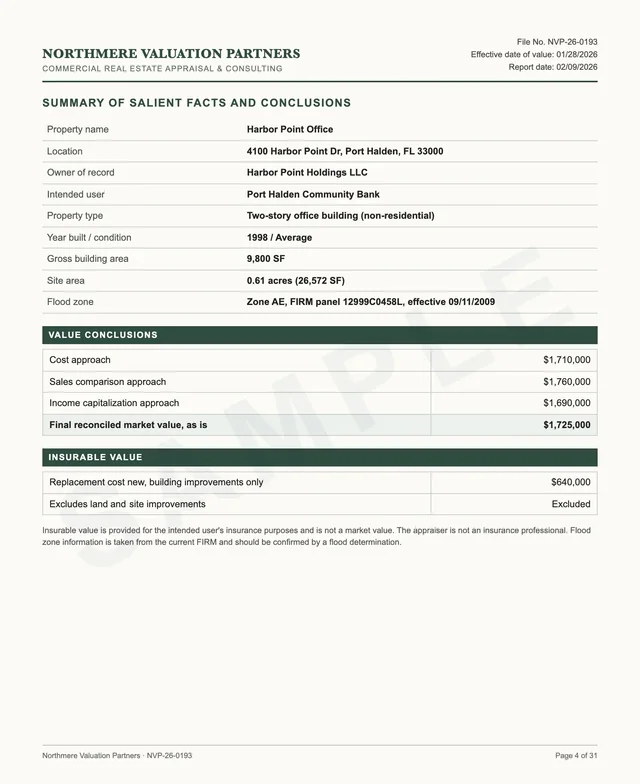
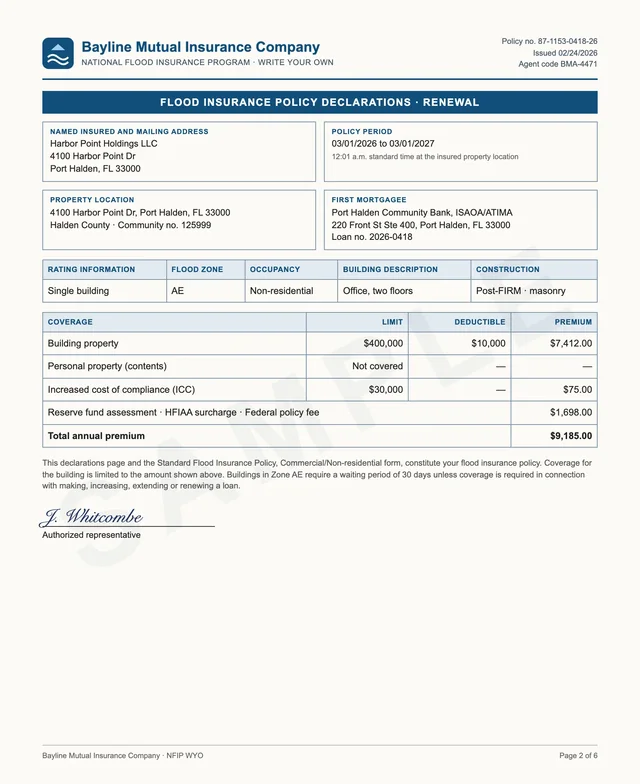
The key points
When a borrower offers a flood policy from a private insurer for a designated loan:
- You must accept it if it meets the regulation’s definition of “private flood insurance” and provides the required amount of coverage.
- You may skip the definition review if the policy, or an endorsement to it, carries the compliance aid statement in the regulation’s words. You still check the amount.
- You may accept it anyway if it doesn’t meet the definition but meets the four discretionary acceptance criteria, and you document in writing that it sufficiently protects the loan.
- You may not accept it if it meets none of these, or, for a mutual aid plan, that provision’s criteria (Q&A Private Flood Compliance 11).
Each step below cites the OCC’s rule, 12 CFR 22.3(c) and 22.2(k); the other regulators’ rules use the same words (see each regulator’s rule). “Q&A” references are to the regulators’ 2022 Interagency Questions and Answers Regarding Flood Insurance.
Mandatory acceptance
You must accept private flood insurance, as the regulation defines it, in satisfaction of the flood insurance requirement if the policy meets the coverage requirement: at least the lesser of the outstanding principal balance and the maximum coverage available for that type of property (12 CFR 22.3(c)(1)). A lender may decide to accept private policies only under this provision and not use discretionary acceptance at all (Q&A Mandatory 1).
The definition, item by item
A policy is “private flood insurance” only if it meets all of the following (12 CFR 22.2(k)). “SFIP” means the NFIP’s standard flood insurance policy in effect when the private policy is provided to you.
The insurer
- Licensed, admitted or otherwise approved to engage in the business of insurance by the insurance regulator of the state where the property is; or, for a difference-in-conditions, multiple-peril, all-risk or other blanket policy on nonresidential commercial property, a surplus lines insurer recognized, or not disapproved, by that regulator. Surplus lines insurers that are eligible, or not disapproved, in the state can also write residential policies under the “otherwise approved” wording (Q&A Private Flood Compliance 10).
Coverage at least as broad as an SFIP
For the same type of property, including deductibles, exclusions and conditions. At a minimum, the policy must:
- define “flood” to include every event the SFIP defines as a flood;
- contain the SFIP’s coverages: building property, personal property if the borrower bought it, other coverages, and increased cost of compliance;
- have deductibles no higher than the SFIP’s maximum, with similar non-applicability provisions, for any total coverage up to the NFIP maximum;
- cover direct physical loss caused by a flood, excluding only causes of loss the SFIP excludes. Other exclusions may apply only to coverage beyond what an SFIP could provide, or must broaden the coverage;
- contain no conditions that narrow the SFIP’s coverage.
Required provisions
- 45 days’ written notice before cancellation or non-renewal, to the insured and to the lender or its servicer;
- information about the availability of flood insurance under the NFIP;
- a mortgage interest clause similar to the SFIP’s;
- a requirement that the insured file suit no later than one year after a written denial of all or part of a claim;
- cancellation provisions as restrictive as the SFIP’s.
Deductibles
Under mandatory acceptance the deductible can’t exceed the SFIP maximum for any total coverage up to the NFIP limit. A policy with more coverage than the NFIP offers, for example $1,000,000 on a commercial building where the NFIP limit is $500,000, may carry a higher deductible, and you should consider whether it’s reasonable for the borrower’s finances (Q&A Private Flood Compliance 1). The policy still has to meet the acceptance rules below. You may also require a lower deductible than the SFIP maximum, consistent with general safety and soundness principles and based on the borrower’s financial condition, among other factors (Q&A Private Flood Compliance 2). Under either kind of acceptance, a deductible equal to the property’s insurable value can’t be used to avoid the requirement (Q&A Private Flood Compliance 1).
The compliance aid statement
You may decide that a policy meets the definition of private flood insurance, without further review, if this statement is in the policy or in an endorsement to it (12 CFR 22.3(c)(2)):
“This policy meets the definition of private flood insurance contained in 42 U.S.C. 4012a(b)(7) and the corresponding regulation.”
The compliance aid statement, word for word in every regulator’s rule
What it does
- It settles the definition question. With the statement in the policy or an endorsement, you don’t need to review the policy against the definition (Q&A Mandatory 5).
- It can be on the declarations page. If you receive only a declarations page and it carries the statement, you may rely on it (Q&A Mandatory 8).
- It tolerates style. Differences in formatting, font or punctuation that don’t change the meaning are fine; different wording isn’t, and then you review the policy yourself (Q&A Mandatory 5).
What it doesn’t do
- It doesn’t check the amount. You still confirm the coverage meets the required amount (Q&A Mandatory 6).
- It isn’t a conformity clause. It doesn’t make a policy meet the definition; it helps you recognize one that does (Q&A Mandatory 3).
- It doesn’t oblige you. You aren’t required to accept a policy on the statement alone, and may make your own determination (Q&A Mandatory 4).
- Its absence isn’t a reason to reject. You can’t turn down a policy only because it lacks the statement; if the policy meets the definition and the amount, you must accept it (Q&A Mandatory 4).
A policy that carries the statement alongside a notice that the insurer isn’t licensed in the state, which suggests a surplus lines insurer, may still be accepted if it complies with the regulation and state law (Q&A Mandatory 9).
Discretionary acceptance
You may accept a private flood policy that doesn’t meet the definition if it meets all four of these criteria (12 CFR 22.3(c)(3)):
The required amount
It provides coverage in the amount the regulation requires.
An approved insurer
It’s issued by an insurer licensed, admitted or otherwise approved by the insurance regulator of the state where the property is, or, for a difference-in-conditions, multiple-peril, all-risk or other blanket policy on nonresidential commercial property, a surplus lines insurer recognized or not disapproved there.
Both loss payees
It covers both the mortgagor and the mortgagee as loss payees. The exception is a policy provided by a condominium association, cooperative, homeowners association or other applicable group, where that association or group pays the premium as a common expense.
Sufficient protection, in writing
It provides sufficient protection of the loan, consistent with general safety and soundness principles, and you document that conclusion in writing.
Discretionary acceptance is your choice; nothing requires you to accept a policy that meets these criteria (Q&A Discretionary 1). The written conclusion can be recorded electronically, and there’s no prescribed form: include what reasonably supports it (Q&A Discretionary 2). Factors the regulators suggest weighing (Q&A Discretionary 3 and Q&A Discretionary 4):
- whether the deductible is reasonable for the borrower’s financial condition;
- whether the insurer gives enough notice of cancellation to allow timely force placement;
- whether per-occurrence and aggregate limits protect your interest in the collateral;
- whether the policy complies with the state’s insurance laws;
- whether the insurer has the solvency, strength and ability to pay claims, which you may check with the state insurance regulator.
A policy accepted this way may have a deductible above the SFIP maximum, as long as you’ve concluded it sufficiently protects the loan (Q&A Private Flood Compliance 1).
Mutual aid plans
A mutual aid society is an organization whose members share a common religious, charitable, educational or fraternal bond, that covers losses to members’ property, including flood damage, under an agreement and in accordance with that common bond, and that has a demonstrated history of fulfilling those agreements for flood losses (12 CFR 22.2(h)). You may accept its plan in place of flood insurance only if (12 CFR 22.3(c)(4)):
- your regulator has determined that such plans qualify as flood insurance;
- the plan provides the required amount of coverage;
- it covers both the mortgagor and the mortgagee as loss payees; and
- it provides sufficient protection of the loan, consistent with general safety and soundness principles, and you document that conclusion in writing.
The order of review
Any time a borrower gives you a new private flood policy, whether or not the loan is being made, increased, extended or renewed, you review it under these rules (Q&A Private Flood Compliance 11). A workable order:
Check the amount
Every path requires at least the required amount of coverage, with every nonexempt building in an SFHA covered (Q&A Mandatory 6; Q&A Amount 6; 12 CFR 22.4 for the exemptions).
 With FloodCaliber™: the policy is read from your loan files and checked against the required amount for each building, with contents where they secure the loan, and each value links to its page.
Look for the compliance aid statement
In the regulation’s words, in the policy, an endorsement or the declarations page. If it’s there and you rely on it, the policy meets the definition and you accept it.
Review against the definition
No statement, or you choose not to rely on it: check the policy item by item. If it meets the definition, you must accept it.
Consider discretionary acceptance
If it doesn’t meet the definition, you may accept it under the four criteria, or a mutual aid plan under its criteria, with your written conclusion on file.
With FloodCaliber™: the policy’s values are linked to its pages, and the acceptance decision, its reason and a second reviewer’s approval stay on record.Otherwise, don’t accept it
If the policy meets none of these, it doesn’t satisfy the requirement. At a triggering event, the required coverage must be in place before the loan closes; the 45 days are no grace period. During the loan’s term, if that leaves the building without the required coverage, the force-placement steps apply.
You may check the discretionary criteria first, but if the policy fails them, you still have to decide whether mandatory acceptance requires you to take it (Q&A Mandatory 7). At renewal you may rely on your earlier review, and its documentation, if the policy’s terms haven’t changed in a way that affects acceptance (Q&A Private Flood Compliance 11).
- Declarations pages. One is enough if it gives you what you need to decide, or carries the statement; if not, ask for more about the policy (Q&A Private Flood Compliance 5).
- Before closing. The rules don’t say which documents you may rely on if the policy isn’t available yet; ask the insurer early for what you need (Q&A Private Flood Compliance 4).
- Secondary market and servicing. Investor requirements, such as Fannie Mae’s or Freddie Mac’s, are separate from the regulation. A servicer applies the regulation for loans it services for supervised lenders, and its contract for others (Q&A Private Flood Compliance 7 and Q&A Private Flood Compliance 8).
Each regulator’s rule
The five regulators adopted the private flood rules together, effective July 1, 2019 (84 FR 4953), implementing the definition in 42 U.S.C. 4012a(b)(7). The definition and the acceptance provisions read the same in each.
| Regulator | Definition | Mandatory, compliance aid, discretionary, mutual aid |
|---|---|---|
| OCC | 12 CFR 22.2(k) | 12 CFR 22.3(c)(1)–(4) |
| Federal Reserve Regulation H | 12 CFR 208.25(b)(9) | 12 CFR 208.25(c)(3)(i)–(iv) |
| FDIC | 12 CFR 339.2 | 12 CFR 339.3(c)(1)–(4) |
| NCUA | 12 CFR 760.2 | 12 CFR 760.3(c)(1)–(4) |
| Farm Credit Administration | 12 CFR 614.4925 | 12 CFR 614.4930(c)(1)–(4) |
Questions lenders ask
Must a lender accept a private flood policy that carries the compliance aid statement?
It may rely on the statement and skip any further review of whether the policy meets the definition of private flood insurance, but it doesn’t have to: it can make its own determination instead (Q&A Mandatory 4). Either way, it must still check that the amount of coverage meets the requirement (Q&A Mandatory 6).
Can a lender reject a private policy because it lacks the compliance aid statement?
Not for that reason alone. A policy that meets the definition of private flood insurance must be accepted as long as it meets the required amount, with or without the statement (Q&A Mandatory 4).
Is a declarations page enough to accept a private flood policy?
If the declarations page carries the compliance aid statement, yes, after you check the amount (Q&A Mandatory 8). Without it, the page is enough only if it gives you the information to decide under the mandatory or discretionary acceptance rules (Q&A Private Flood Compliance 5).
Can a multiple-peril policy satisfy the flood insurance requirement?
Yes, if it covers flood in the policy or by endorsement and meets the private flood insurance rules (Q&A Private Flood Compliance 6).
When does a lender have to review a private flood policy?
Every time the borrower presents a new private policy, whether or not a triggering event has happened (Q&A Private Flood Compliance 11). At renewal, you may rely on your earlier review and its written documentation if nothing in the policy that affects acceptance has changed.
Sources
Rule text from the eCFR, current as of November 5, 2026, when we checked it on November 7, 2026.
- OCC: 12 CFR 22.2, Definitions; 12 CFR 22.3, Requirement to purchase flood insurance where available
- Federal Reserve: 12 CFR 208.25 (Regulation H)
- FDIC: 12 CFR 339.2 and 12 CFR 339.3
- NCUA: 12 CFR 760.2 and 12 CFR 760.3
- Farm Credit Administration: 12 CFR 614.4925 and 12 CFR 614.4930
- Loans in Areas Having Special Flood Hazards, final rule, 84 FR 4953, February 20, 2019
- Interagency Questions and Answers Regarding Flood Insurance, 87 FR 32826, May 31, 2022: Mandatory, Discretionary and Private Flood Compliance
How FloodCaliber™ handles this
FloodCaliber™ runs inside your environment and reads NFIP and private flood policies the same way, from your loan files.
- The amount. The policy is checked against the required amount, building by building, with contents where they secure the loan.
- The evidence. Each value links to its page in the policy, so your reviewer can see what was read and where.
- The acceptance record. The policy, the amount check and the acceptance decision stay on record with the evidence, approved by a second reviewer.
Our team works with your flood and compliance staff as a partner in flood compliance, with your flood manual, source priorities and exceptions agreed with your team during implementation.
FloodCaliber™ supports your compliance program but does not guarantee compliance. Acceptance decisions stay with your team.