
The key points
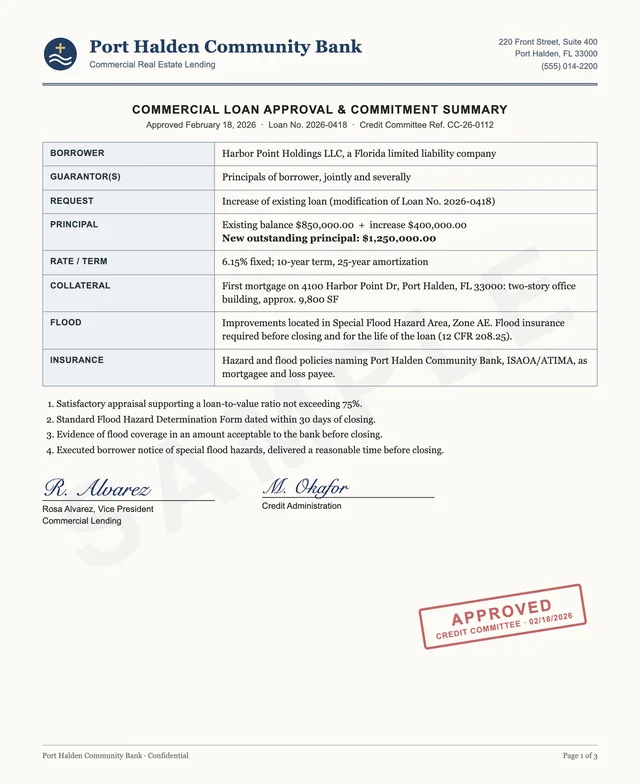
- When: every time you make, increase, extend or renew a loan secured by a building or mobile home located, or to be located, in an SFHA, whether or not flood insurance is available (12 CFR 22.9(a)).
- Who: the borrower, a reasonable time before the transaction closes, and the servicer (22.9(c)). Ten calendar days is generally reasonable (Q&A Notice 2).
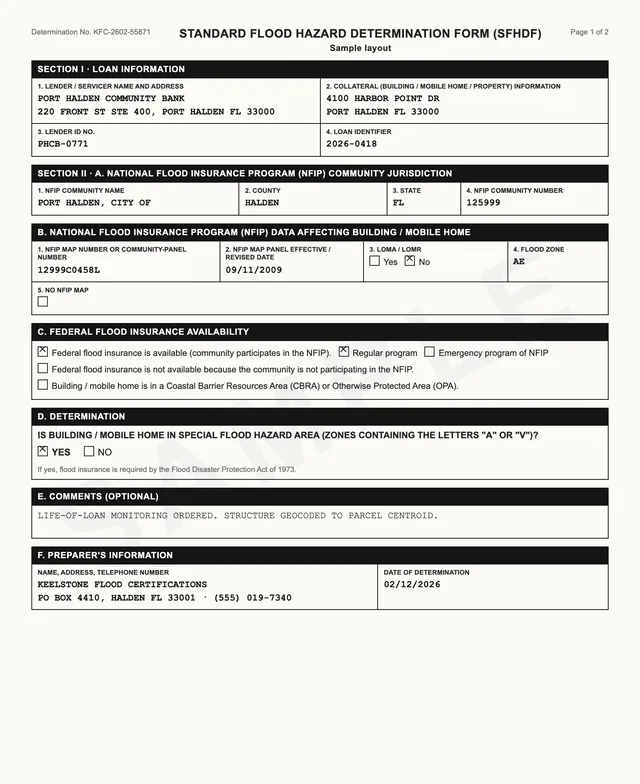
- What: six required statements (22.9(b)), or the sample form in Appendix A to Part 22 (22.9(f)).
- Record: keep a record of the borrower’s and servicer’s receipt while you own the loan (22.9(d)).
Rule citations are to the OCC’s Part 22; the Federal Reserve (208.25(i)), FDIC (339.9), NCUA (760.9) and Farm Credit Administration (614.4955) rules say the same. “Q&A” references are to the 2022 Interagency Questions and Answers.
Who gets the notice, and when?
- One borrower is enough. In a transaction with several borrowers, notice to any one of them meets the rule; you may send more (Q&A Notice 1).
- A reasonable time before closing, so the borrower understands the obligation and can buy insurance before the loan closes. The regulators generally regard 10 calendar days as reasonable (Q&A Notice 2).
- The servicer: as promptly as practicable after the borrower, and no later than when you send the servicer other notices on hazard insurance and taxes. A copy of the borrower’s notice, on paper or electronically, is enough, and there’s no exception for an affiliated servicer (22.9(c); Q&A Notice 3 and Q&A Notice 4).
- Every triggering event, even for the same borrower, property and lender within seven years: reusing a determination doesn’t reuse the notice (Q&A Notice 6).
- Sales and leases: instead of notifying the purchaser or lessee yourself, you may get written assurance that the seller or lessor did, and keep it while you own the loan (22.9(e)).
- Mobile homes: if you learn just before closing that the home will sit in an SFHA, you may need to delay closing to give the notice. “Home only” loans on homes not on a permanent foundation fall outside the notice rule (Q&A Notice 2).
What must the notice say?
The written notice must include (12 CFR 22.9(b)):
- a warning, in a form FEMA approves, that the building or mobile home is or will be in a special flood hazard area;
- a description of the flood insurance purchase requirements in section 102(b) of the Flood Disaster Protection Act;
- where applicable, that flood insurance is available from private insurers that issue NFIP policies, or directly from the NFIP;
- that flood insurance with the same level of coverage as an NFIP policy may also be available from a private insurer issuing its own policies;
- that the borrower is encouraged to compare coverage, deductibles, exclusions, conditions and premiums between NFIP and private policies, and to direct questions to an insurance agent; and
- whether federal disaster relief assistance may be available for flood damage in a federally declared disaster.
The sample form. Using the language in Appendix A to Part 22 meets the borrower-notice requirement, but it isn’t mandatory. You may change its format and add information, as long as your version keeps the required minimum (22.9(f); Q&A Notice 7). For residential loans that must be escrowed, the escrow notice goes with it (12 CFR 22.5(b); see escrow).
The record of the borrower’s receipt
Keep a record of receipt by the borrower and the servicer for as long as you own the loan (22.9(d)). Examples the regulators give: the borrower’s signed or initialed acknowledgment, an electronic signature acknowledging receipt, or a certified mail return receipt. Electronic records are fine if you can retrieve them within a reasonable time when your regulator asks (Q&A Notice 5).
How is it different from the force-placement notice?
| Topic | Notice of special flood hazards | Force-placement notice |
|---|---|---|
| When | To the borrower before a loan is made, increased, extended or renewed; to the servicer as promptly as practicable after | Any time during the loan that coverage is found missing or short |
| To whom | The borrower and the servicer | The borrower |
| Says | The building is in an SFHA, the purchase requirement that applies, where to get insurance, disaster relief | Buy the required coverage; if not within 45 days, the lender will |
| Form | Six required statements; sample form in Appendix A | No required form |
| Rule | 12 CFR 22.9 | 12 CFR 22.7(a); see our force-placement guide |
Questions lenders ask
Does the borrower have to sign the notice?
The rule requires a record of receipt, not a particular form of it. A signed or initialed acknowledgment is one example; an electronic signature or a certified mail receipt are others (Q&A Notice 5).
Is the notice required if flood insurance isn’t available?
Yes. It goes out “in all cases whether or not flood insurance is available” for the collateral (12 CFR 22.9(a); Q&A Applicability 1).
What if the notice is late?
It must reach the borrower a reasonable time before closing. Missing the notice is one of the violations that, as a pattern or practice, brings mandatory civil money penalties (Q&A Penalty 1; see penalties).
Sources
Rule text from the eCFR, current as of November 5, 2026, when we checked it on November 7, 2026.
- OCC: 12 CFR 22.9, Notice of special flood hazards and availability of Federal disaster relief assistance, and Appendix A to Part 22. The same rule: Federal Reserve 12 CFR 208.25(i); FDIC 339.9; NCUA 760.9; Farm Credit Administration 614.4955
- Interagency Questions and Answers Regarding Flood Insurance, 87 FR 32826, May 31, 2022: Notice
How FloodCaliber™ handles this
FloodCaliber™ runs the review behind the notice across your loan files, inside your environment.
- Reads the loan files, including the determination and notices, with each value linked to its page.
- Runs at every triggering event. The calculation reruns at every make, increase, renew or extend, with the record of what changed.
- Builds the exam record. A workbook, a PDF report and an evidence package for every approved review.
Our team works with your lending and compliance staff as a partner in flood compliance.
FloodCaliber™ does not guarantee compliance.