
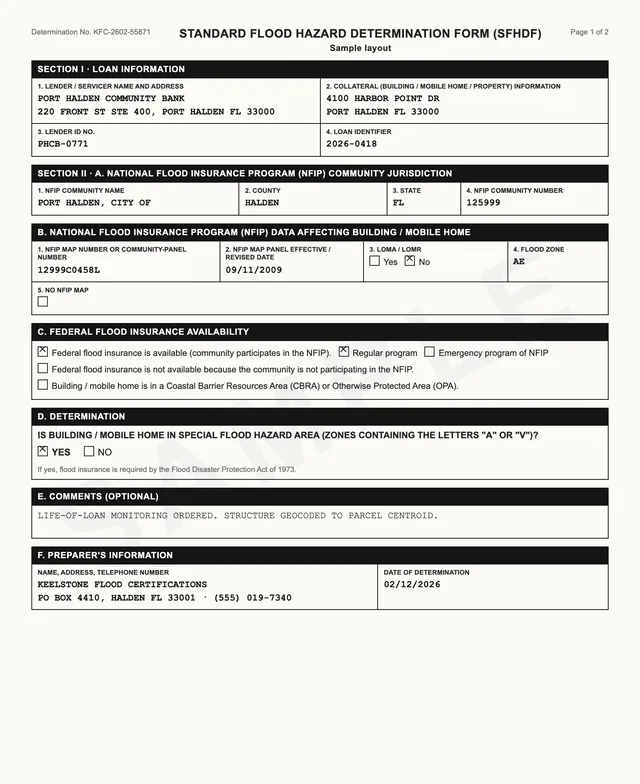
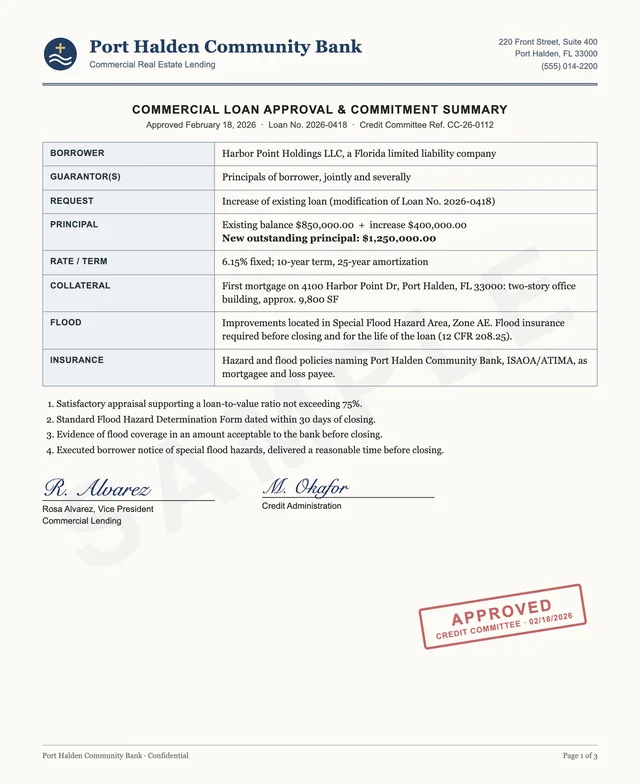
What is a triggering event?
A triggering event happens when a designated loan is made, increased, extended or renewed, sometimes called a MIRE or MIER event (Q&A Applicability 13). A lender may not make, increase, extend or renew a designated loan unless the required flood insurance is in place for the term of the loan (12 CFR 22.3(a)). Between triggering events, the force-placement rule covers lapses and shortfalls.
What must a lender do at a triggering event?
Determine the flood zone
Or reuse a determination no more than seven years old with no map change since, where allowed (reusing a determination).
Give the notice of special flood hazards
When the building is in an SFHA, whether or not insurance is available: to the borrower a reasonable time before closing, every time, and to the servicer as promptly as practicable after the borrower (notice of special flood hazards).
Require the right amount, in place at closing
For a designated loan, worked again for the new balance (how much is required). Use the closing date: in a “dry” settlement state, the date ownership transfers; for a refinance, the consummation date (Q&A Applicability 15).
Escrow residential loans
For a residential designated loan, unless an exception applies (escrow).
Notify FEMA’s designee of the servicer
When the building is in an SFHA, and again within 60 days of any change of servicer (12 CFR 22.10).
Q&A Applicability 13 lists these requirements for a triggering event.
Which loan events are triggering events?
| Event | Triggering event? | Why |
|---|---|---|
| New loan, including a refinance | Yes | A refinance is the making of a loan (Q&A Force Placement 13) |
| Table-funded loan | Yes, for the funding lender | Treated as made by the party advancing the funds (Q&A Applicability 7) |
| Increase in principal beyond what the contract contemplated | Yes | An increase (Q&A Applicability 6) |
| Maturity extended | Yes | An extension (Q&A Applicability 6) |
| Modification that capitalizes delinquent amounts, same maturity | No | Doesn’t increase, extend or renew the loan (Q&A Applicability 6) |
| Automatic extension agreed at origination | No | Part of the original contract (Q&A Applicability 11) |
| Purchase of a loan | No | Not making, increasing, extending or renewing; but if you learn coverage is needed, the rules apply (Q&A Applicability 5) |
| Buying into a participation or syndication after the loan is made | No | Each participant stays responsible for compliance, so the regulators expect due diligence on the lead lender’s controls up front and over the loan’s term. Lenders whose funds are advanced together at origination are making the loan (Q&A Applicability 9) |
| Cashless roll | No | Doesn’t increase the committed debt (Q&A Applicability 10) |
| Assumption by another borrower | No | Listed as not a triggering event (Q&A Applicability 13) |
| Remapping into an SFHA | No | But it starts the force-placement steps (Q&A Applicability 13; map changes) |
| Force-placed premium capitalized | Depends | Not an increase if the contract permits the advance; an increase if it doesn’t (Q&A Force Placement 10) |
Lines of credit, junior liens and assumptions
- Draws on an approved line don’t need new determinations; a requested increase in the line may (Q&A Other Security Interests 2).
- Home equity loans secured by a building in an SFHA are designated loans whatever their lien position (Q&A Other Security Interests 1).
- A second mortgage made, increased, extended or renewed needs coverage for the lesser of the combined balance of the first and second loans, the NFIP maximum and the insurable value, not just the second loan’s balance (Q&A Other Security Interests 4).
- Another borrower assuming the loan isn’t a triggering event on its own; an assumption that also increases, extends or renews the loan is (Q&A Applicability 13).
Example: a renewal after a map change
Example. Fictional loan files.
A $600,000 commercial loan secured by a warehouse with an insurable value of $450,000 was made in 2021, when the warehouse was in Zone X. FEMA remapped it into Zone AE in 2025. The lender’s portfolio review caught the map change, sent the force-placement notice, and the borrower bought a $450,000 policy within 45 days. Now, in 2026, the loan is renewing for three more years.
- The renewal is a triggering event. The 2025 remapping wasn’t; it started the force-placement steps instead.
- New determination needed. The 2021 determination can’t be reused: a map revision has affected the property since.
- New notice of special flood hazards, a reasonable time before the renewal closes.
- The amount: the lesser of the $600,000 balance and the most available, the lower of the $500,000 limit and the $450,000 insurable value. $450,000, which the borrower’s policy covers.
- No escrow: a commercial loan is excepted.
Questions lenders ask
Is a loan modification a triggering event?
Only if it increases, extends or renews the loan, for example adding amounts the contract didn’t contemplate or extending the maturity. Capitalizing delinquent payments at the same maturity isn’t (Q&A Applicability 6).
Do we have to review loans we buy?
Buying a loan isn’t a triggering event, but if you learn coverage is required and missing, the rules, including force placement, apply. Due diligence on purchased loans may be prudent (Q&A Applicability 5).
Do we have to review our whole portfolio?
No. Beyond triggering events, the rules apply when you know or have reason to know coverage is needed; many lenders review periodically anyway (Q&A Applicability 8).
Sources
Rule text from the eCFR, current as of November 5, 2026, when we checked it on November 7, 2026.
- OCC: 12 CFR 22.3, 22.9 and 22.10. The same rules: Federal Reserve 12 CFR 208.25; FDIC Part 339; NCUA Part 760; Farm Credit Administration Part 614, subpart S
- Interagency Questions and Answers Regarding Flood Insurance, 87 FR 32826, May 31, 2022: Applicability, Other Security Interests, Force Placement
How FloodCaliber™ handles this
FloodCaliber™ reviews every triggering event the same way, from your loan files, inside your environment.
- Runs again at every make, increase, renew or extend, with the record of what changed.
- Works out the exact amount for the new balance, building by building, with each value linked to its page.
- Catches what happens in between. Lapses, shortfalls and flood-zone changes flagged on the portfolio dashboard.
Our team works with your lending and compliance staff as a partner in flood compliance.
FloodCaliber™ does not guarantee compliance.