
The key points
- Work the unit’s requirement: the lesser of the outstanding principal balance, $250,000, and the unit’s share of the building’s replacement cost (the building’s replacement cost divided by the number of units).
- Credit the RCBAP at its coverage divided by the number of units.
- If that falls short, ask the association to raise the RCBAP; if it doesn’t, require the borrower to buy supplemental coverage for the difference.
- If there’s no RCBAP, the borrower insures the unit for the full requirement.
That’s Q&A Condo and Co-Op 3 to Q&A Condo and Co-Op 5 of the regulators’ 2022 Interagency Questions and Answers Regarding Flood Insurance. The requirement also covers other residential condo lending, such as loans to a developer to build the condominium or loans to the association (Q&A Condo and Co-Op 1).
What is the RCBAP?
- A master policy the NFIP sells only to condominium associations, for a residential condominium building: one with at least 75 percent of its floor area in residential use.
- What it covers: the common and individually owned building elements, improvements within the units, and contents owned in common, if the association buys contents coverage.
- How much: up to the lesser of 100 percent of the building’s replacement cost, including the foundation and supporting structures, and $250,000 times the number of units. Contents coverage is limited to $100,000 in total, not per unit.
- Where: only in communities in the NFIP’s regular program.
How is the unit’s required amount worked out?
The minimum for a residential unit is the lesser of the outstanding principal balance and the most NFIP coverage available for the unit, which is the lesser of $250,000 and the unit’s insurable value: the building’s replacement cost value divided by the number of units (Q&A Condo and Co-Op 3).
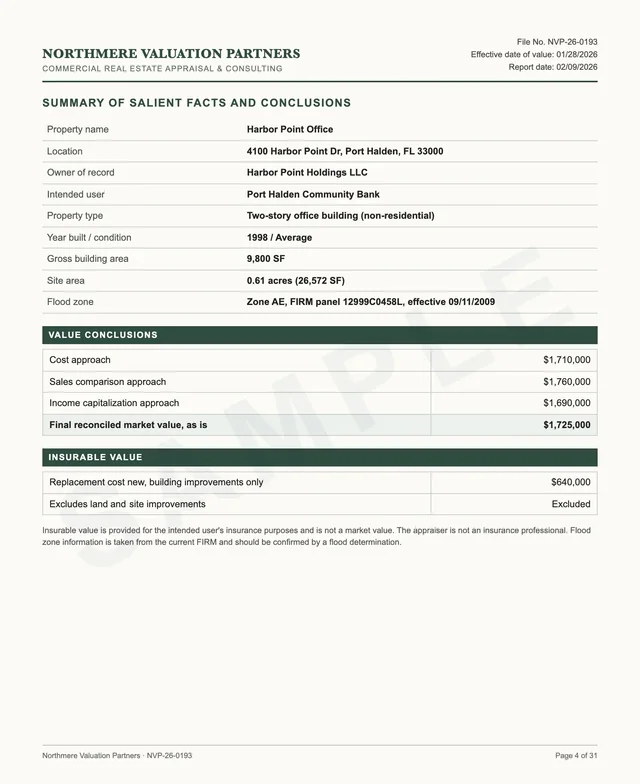
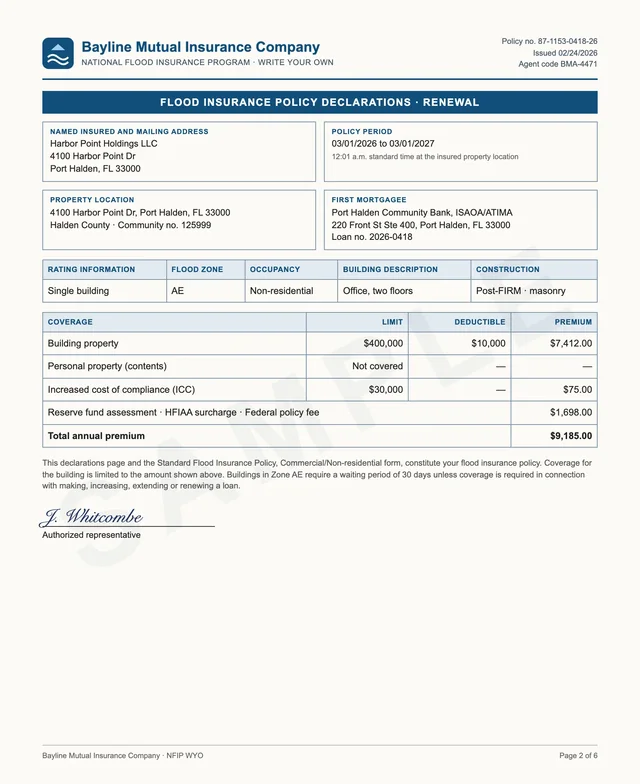
FEMA requires the RCBAP declarations page to show the building’s replacement cost value and the number of units. You may rely on those figures unless they clearly conflict with other information; if they do, tell the borrower why, and if the unit is underinsured, require supplemental coverage (Q&A Condo and Co-Op 3).
Three examples from the Q&As
Each is a unit in a 50-unit residential condominium building in an SFHA, in a participating community.
| Case | The numbers | What’s required |
|---|---|---|
| Adequate RCBAP Q&A Condo and Co-Op 3 | Balance $300,000. Building replacement cost $15 million, so $300,000 a unit. RCBAP $12.5 million, so $250,000 a unit. | Requirement $250,000, the NFIP unit limit. The RCBAP covers it; nothing more is needed. |
| No RCBAP Q&A Condo and Co-Op 4 | Balance $175,000. Building replacement cost $10 million, so $200,000 a unit. | Requirement $175,000, the balance. The borrower buys at least $175,000 of coverage on the unit. |
| RCBAP at 80% Q&A Condo and Co-Op 5 | Balance $300,000. Building replacement cost $10 million, so $200,000 a unit. RCBAP $8 million, so $160,000 a unit. | Requirement $200,000, the unit’s insurable value. The borrower buys $40,000 of supplemental coverage. |
An NFIP Dwelling Policy is one option for the supplemental coverage; a private policy that meets your acceptance rules can also satisfy the requirement (see our private flood guide). A Dwelling Policy responds after the RCBAP’s limits for the unit; it doesn’t extend the RCBAP’s limits, and the NFIP combination can’t exceed $250,000 a unit (Q&A Condo and Co-Op 4, Q&A Condo and Co-Op 5 and Q&A Condo and Co-Op 8).
Why the association’s amount matters. If the RCBAP carries less than 80 percent of the lesser of the building’s replacement cost and the NFIP maximum for the building, a co-insurance penalty reduces claim payments. In the Q&As’ example, a building that should carry $200,000 but carries $180,000 gets 90 percent of a $150,000 loss, less the deductible (Q&A Condo and Co-Op 7).
What if the RCBAP lapses?
If you find during the loan that the unit isn’t covered, or is covered for less than the requirement, notify the unit owner. Encourage them to work with the association on a new RCBAP; failing that, require the unit owner to buy a policy. If neither the borrower nor the association obtains enough coverage within 45 days of your notice, you must force-place it (Q&A Condo and Co-Op 6). The steps are in our force-placement guide.
Which units and co-ops does the rule not reach?
- A unit in a non-residential condominium building, residential or not, and a non-residential unit in a residential condominium building: the NFIP doesn’t offer building coverage for these units, so a loan secured by one isn’t a designated loan. NFIP contents coverage is available for them (Q&A Condo and Co-Op 9).
- A share in a cooperative: the unit holder owns stock with a right to occupy, not title to the building, so a loan secured by the share isn’t a designated loan. The cooperative may insure the building under the General Property Form for safety and soundness (Q&A Condo and Co-Op 10).
Does a condo unit loan need flood escrow?
When a unit is adequately covered by an RCBAP whose premiums the association pays as a common expense, the loan doesn’t need flood escrow. A supplemental policy the unit owner buys because the RCBAP falls short is escrowed, unless another exception applies (Q&A Escrow Loan Exceptions 2 and Q&A Escrow Loan Exceptions 3). See our escrow guide.
Questions lenders ask
How much flood insurance does a condo unit loan need?
The lesser of the outstanding principal balance, $250,000, and the unit’s share of the building’s replacement cost (Q&A Condo and Co-Op 3).
What if the RCBAP doesn’t cover enough?
Ask the borrower to ask the association to raise the RCBAP. If it doesn’t, require the borrower to buy supplemental coverage for the difference (Q&A Condo and Co-Op 5).
What happens when the association lets its RCBAP lapse?
Notify the unit owner, encourage a new RCBAP, and failing that require the owner to insure the unit; if they don’t within 45 days, force place it (Q&A Condo and Co-Op 6).
Does a loan on a commercial condo unit need flood insurance?
No federal requirement. The NFIP doesn’t insure a unit in a non-residential condo building, or a non-residential unit in a residential one, so the loan isn’t a designated loan (Q&A Condo and Co-Op 9).
Does a loan secured by co-op shares need flood insurance?
No. A co-op owner holds shares, not title to the building, so the loan isn’t a designated loan. The cooperative may still insure the building itself (Q&A Condo and Co-Op 10).
Sources
Rule text from the eCFR, current as of November 5, 2026, when we checked it on November 7, 2026.
- OCC: 12 CFR 22.3, Requirement to purchase. The same rule: Federal Reserve 12 CFR 208.25; FDIC 339.3; NCUA 760.3; Farm Credit Administration 614.4930
- NFIP: 44 CFR 61.6, maximum coverage
- Interagency Questions and Answers Regarding Flood Insurance, 87 FR 32826, May 31, 2022: Condo and Co-Op, Amount and Escrow Loan Exceptions
How FloodCaliber™ handles this
FloodCaliber™ runs inside your environment and works condos the way it works every file: from your loan files, with each value linked to its page.
- Condos, contents and private policies. Coverage is worked building by building, including condos, with each value linked to its page.
- Values that disagree are shown. If two documents give different values, both are shown for your reviewer to decide, and the choice and reason are recorded.
- Lapses tracked. A shortfall is flagged, the notice is prepared, and the 45 days are tracked from the confirmed notice date.
Our team works with your flood, mortgage and compliance staff as a partner in flood compliance.
FloodCaliber™ supports your compliance program but does not guarantee compliance.