
The key points
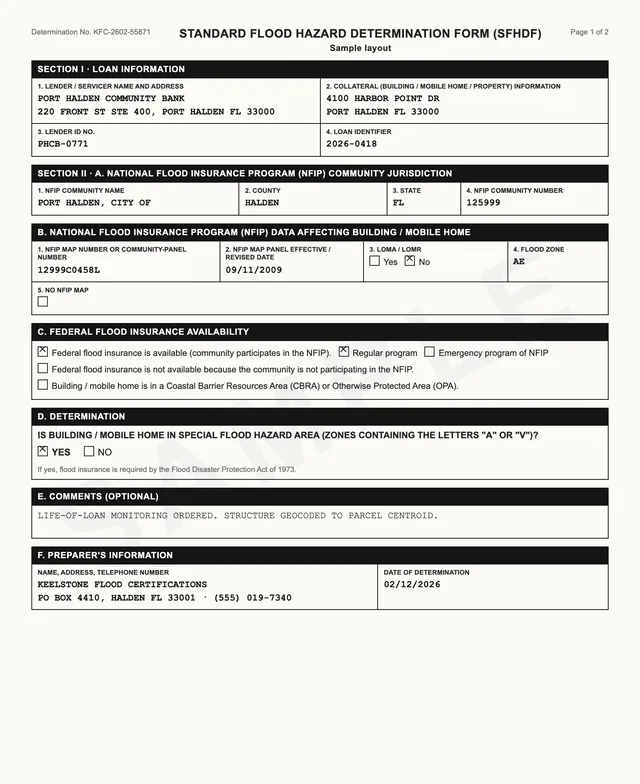
- Use FEMA’s Standard Flood Hazard Determination Form (SFHDF) to decide whether each building or mobile home securing a loan is, or will be, in an SFHA where NFIP insurance is available (12 CFR 22.6(a)).
- Do it for loans secured by buildings anywhere, not only in flood zones: the determination rule applies regardless of location (12 CFR 22.1(b)).
- Keep the completed form for as long as you own the loan (12 CFR 22.6(b)).
- The determination isn’t the notice. If the building is in an SFHA, the borrower still gets the notice of special flood hazards (Q&A SFHDF 1).
Rule citations are to the OCC’s Part 22; the Federal Reserve (208.25(f)), FDIC (339.6), NCUA (760.6) and Farm Credit Administration (614.4940) rules say the same. “Q&A” references are to the 2022 Interagency Questions and Answers.
When is a flood zone determination required?
- At every triggering event: when you make, increase, extend or renew a loan secured by a building or mobile home, unless you can reuse an earlier determination (see below and make, increase, renew, extend).
- Before building, too: for a construction loan, determine where the building to be built will sit, before origination (Q&A Construction 2).
- For every building securing the loan. Only buildings in an SFHA need flood insurance, and a building that’s even partly in the SFHA counts (Q&A Applicability 3).
- Even if a structure may be exempt. Make the determination first, then apply any exemption (Q&A Exemptions 3).
- Even outside the NFIP. In a community that doesn’t participate, you still determine, and give the notice if the building is in an SFHA (Q&A Applicability 1).
- Not for each draw on a line of credit. A determination is required before the line is made; draws on an approved line don’t need new ones, though an increase in the line may (Q&A Other Security Interests 2).
What must the SFHDF contain?
- FEMA’s form, in any medium. It may be used in printed, computerized or electronic form (12 CFR 22.6(a)). An electronic version needn’t copy the layout but must contain every mandatory field, and you must be able to reproduce it when your regulator asks (Q&A SFHDF 3).
- The borrower may get a copy. It isn’t required, and the borrower needn’t sign for it; FEMA’s review process (a Letter of Determination Review) needs the determination available to the borrower (Q&A SFHDF 2).
- Kept while you own the loan, on paper or electronically (12 CFR 22.6(b)).
When can a determination be reused?
You may rely on a previous determination when you increase, extend, renew or purchase a loan, if it’s no more than seven years old, its basis is on the SFHDF, and no map revision or update has affected the property since (42 U.S.C. 4104b(e)). The same lender may also rely on its own earlier determination, on those conditions, for a refinancing or assumption, or another loan to the same borrower on the same property. A refinancing or assumption by a different lender is a new loan and needs a new determination (Q&A SFHDF 4).
Reusing a determination doesn’t reuse the notice: each triggering event needs a new notice of special flood hazards (Q&A Notice 6).
Who pays the determination fee?
You, or your servicer, may charge the borrower a reasonable determination fee when the determination (12 CFR 22.8; Q&A Fees 1):
- is made for a making, increase, extension or renewal the borrower initiated;
- reflects FEMA’s revision or updating of flood plain areas or flood-risk zones;
- reflects a FEMA notice or compendium that affects the area, or that FEMA determines may reasonably require a new determination; or
- results in force-placed insurance.
The fee may include life-of-loan monitoring, but only in those situations, and not if the loan doesn’t close (Q&A Fees 2). A purchaser or transferee of the loan may be charged on a sale or transfer (12 CFR 22.8(c)).
Flood zone disputes and discrepancies
- The borrower disputes the zone. Try to resolve it with the determination provider first. An appeal can go to FEMA as a Letter of Determination Review (LODR) or a Letter of Map Change (LOMA, LOMR or LOMR-F). Until FEMA decides the building isn’t in an SFHA, the required coverage stays in place (Q&A Zone 3).
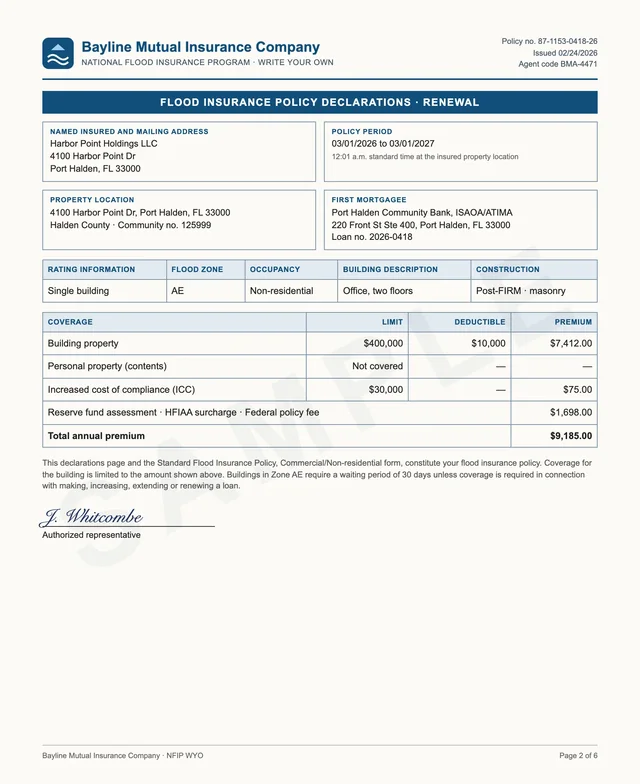
- The policy shows a different zone. You needn’t reconcile it, and it isn’t a violation. NFIP premiums under Risk Rating 2.0 don’t depend on the zone; your determination decides whether the building is in an SFHA (Q&A Zone 1 and Q&A Zone 2).
- The map changes later. A remapping into an SFHA starts the force-placement steps from its effective date. See flood map changes.
Questions lenders ask
What is a flood zone determination?
A finding, on FEMA’s Standard Flood Hazard Determination Form, of whether a building or mobile home securing a loan is in a special flood hazard area where NFIP insurance is available. It decides whether the federal purchase requirement applies.
Who makes it?
The lender is responsible for it; many lenders order it from a flood determination company. FloodCaliber™ reads the completed form from your loan files; it doesn’t produce or sell determinations.
How long is a flood determination good for?
Up to seven years for reuse on an increase, extension, renewal or purchase, or a same-lender refinancing, if the basis is on the form and no map change has affected the property (42 U.S.C. 4104b(e); Q&A SFHDF 4).
Sources
Rule text from the eCFR, current as of November 5, 2026, when we checked it on November 7, 2026.
- OCC: 12 CFR 22.6, Required use of standard flood hazard determination form; 22.8, Determination fees; 22.1, Scope
- Flood Disaster Protection Act, 42 U.S.C. 4104b(e), as summarized in Q&A SFHDF 4
- Interagency Questions and Answers Regarding Flood Insurance, 87 FR 32826, May 31, 2022: SFHDF, Fees, Zone, Applicability, Exemptions
How FloodCaliber™ handles this
FloodCaliber™ reads the determination in your loan files and puts its answer to work, inside your environment.
- Reads the SFHDF. The zone and determination details for each building, linked to the page they came from.
- Checks FEMA data. Your loans on FEMA’s flood zone map in the portfolio dashboard, with flood-zone changes flagged.
- Works out the coverage. For each building in an SFHA, the exact amount the loan requires.
Our team works with your flood and lending staff as a partner in flood compliance. FloodCaliber™ doesn’t sell flood determinations; it reads the ones you already get.
FloodCaliber™ does not guarantee compliance.