
The key points
For a designated loan, the flood insurance must be at least the lesser of the outstanding principal balance and the maximum coverage available for the particular type of property, and it covers the buildings and any personal property securing the loan, not the land (12 CFR 22.3(a)). In practice:
- List the collateral that counts: each nonexempt building securing the loan in a special flood hazard area (SFHA) of a community in the NFIP, and any contents securing the loan inside those buildings.
- For each building, take the lower of its insurable value and the NFIP limit for its type. Do the same for contents.
- Add them up, and compare the total with the outstanding principal balance. The lower number is the federal minimum for the loan.
- If the balance is the lower number, allocate it so that every building in the SFHA, and the contents, carries a reasonable amount (Q&A Amount 6; Q&A Other Security Interests 7).
“Q&A” references are to the regulators’ 2022 Interagency Questions and Answers Regarding Flood Insurance. Rule citations are to the OCC’s Part 22; the Federal Reserve (12 CFR 208.25), FDIC (Part 339), NCUA (Part 760) and Farm Credit Administration (Part 614, subpart S) rules say the same.
Which collateral counts?
- Buildings in an SFHA, in a participating community. Only the buildings securing the loan that sit in an SFHA where NFIP insurance is available need coverage. If any part of a building is in the SFHA, the whole building does; a building on a part of the lot outside the SFHA doesn’t, even if the rest of the lot is in it (Q&A Applicability 3).
- Contents inside a building that secures the loan. If a building in the SFHA and its contents both secure the loan, both need coverage (Q&A Other Security Interests 7).
- Not contents on their own. A loan secured only by inventory or equipment, with no building as collateral, isn’t a designated loan (Q&A Other Security Interests 6). And on a designated loan, contents kept in a building that doesn’t secure the loan need no flood insurance, wherever that building is (Q&A Other Security Interests 8).
- The security documents decide. When a building in the SFHA secures the loan, coverage is required for it and for any pledged contents inside it, even if the security interest was taken “out of an abundance of caution” and whether or not the interest in the contents is perfected (Q&A Other Security Interests 9 and Q&A Other Security Interests 10).
- Three exemptions. State-owned property self-insured to FEMA’s satisfaction; a loan with an original principal balance of $5,000 or less and a repayment term of one year or less; and a structure on residential property that’s detached from the home and doesn’t serve as a residence (12 CFR 22.4; see our guide to the exemptions). The detached-structure exemption doesn’t reach structures used primarily for business, farming or other commercial purposes (Q&A Exemptions 2).
A building of limited value or use still needs coverage unless an exemption applies. The Q&As mention carving it out of the collateral instead, and warn lenders to weigh what that does to the property’s value in a foreclosure (Q&A Applicability 2).
What counts as a building?
The flood rules define a building as “a walled and roofed structure, other than a gas or liquid storage tank, that is principally above ground and affixed to a permanent site,” including one under construction, alteration or repair (12 CFR 22.2(c)). The NFIP’s standard policy is more specific: a structure with “two or more outside rigid walls and a fully secured roof that is affixed to a permanent site,” and not a gas or liquid storage tank, shipping container, recreational vehicle or similar vehicle (General Property Form, II.C.6; FEMA glossary).
| Structure | A building? | Why |
|---|---|---|
| Kiosk or shed with walls and a roof, on a slab | Yes | Walled, roofed and affixed to a permanent site, however small |
| Freestanding pavilion, carport or canopy without walls | No | A roof without walls isn’t “walled and roofed,” and the NFIP policy needs two or more outside rigid walls. One attached to a building is part of that building (III.A.3, III.A.4.a) |
| Open structures such as a ride’s track or a tower | No | Not walled and roofed |
| Truck, or a food cart that stays on its wheels | No | Not affixed to a permanent site. The NFIP policy also excludes self-propelled vehicles, with narrow exceptions (IV.5), and recreational vehicles (IV.4). A manufactured home, or a travel trailer without wheels on a permanent foundation, can be a building (II.C.6) |
| Gas or liquid storage tank | No | Excluded by the definition itself |
| Elevators, furnaces, central air, walk-in freezers | Part of the building | Insured as building property under Coverage A, not as contents (III.A.4) |
| Land, paving, fences, docks | No | Flood insurance doesn’t cover land, and the policy excludes these (IV.6, IV.9, IV.12) |
Roman numerals refer to sections of the NFIP General Property Form, 44 CFR Part 61, Appendix A(2).
The three numbers behind the amount
For a single building, the required amount is the lesser of the outstanding principal balance and the most NFIP insurance available, which is itself the lesser of the NFIP limit for that type of building and the building’s insurable value (Q&A Amount 5).
1. The outstanding principal balance
Of the loan, or of all the loans the property secures. If the insurable value is lower than the balance, you don’t insure up to the balance: flood insurance doesn’t cover land (Q&A Amount 7).
2. The NFIP limit for the type of property
| Type | Building | Contents |
|---|---|---|
| Single-family and two-to-four family | $250,000 | $100,000 |
| Other residential, including multifamily | $500,000 | $100,000 |
| Residential condominium building (RCBAP) | $250,000 times the number of units | $100,000 total, not per unit |
| Non-residential | $500,000 | $500,000 |
These are regular program limits; communities in the emergency program have lower ones. Each NFIP policy insures one building and the contents inside it (General Property Form I.E and III.B.1), and limits apply per policy: several tenants in one building may each insure their contents up to the limit (44 CFR 61.6, note 2). Contents in other residential buildings are limited to $100,000 (44 CFR 61.6, note 3), even though the 2022 Q&As describe General Property Form contents generally at $500,000 (Q&A Amount 1).
3. The building’s insurable value
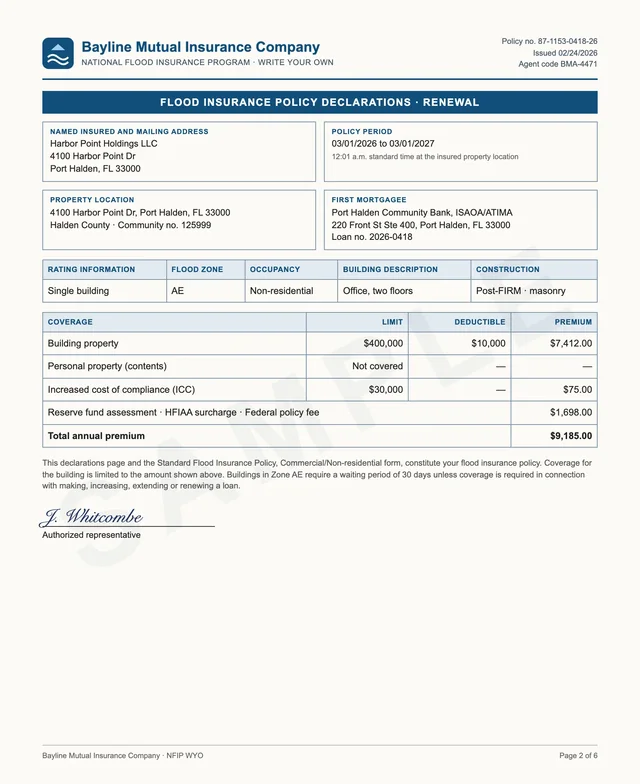
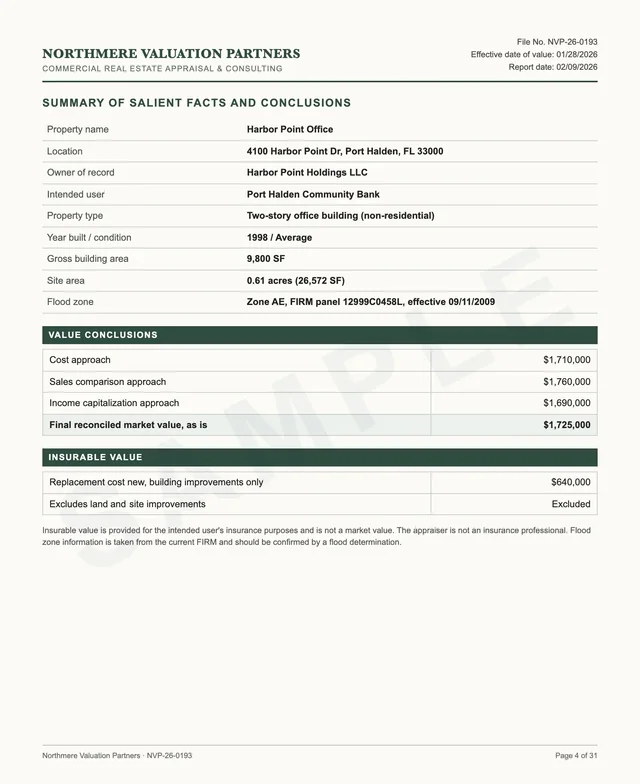
Generally the same as 100 percent replacement cost value: the cost to replace the building with the same kind of material and construction, without deducting depreciation. For flood insurance it includes the foundation and supporting structures, and excludes land (Q&A Amount 1). You and the borrower may use any reasonable, supportable method: a cost-approach appraisal (not market value), a construction-cost calculation, the hazard policy’s insurable value with adjustments, or the replacement cost on the flood policy’s declarations page (Q&A Amount 2).
Several buildings, one loan
Work out the most NFIP coverage available for each building in the SFHA, its limit or its insurable value, whichever is lower, and add them up. The total required is the lesser of that sum and the outstanding principal balance. You may spread the total across the buildings in varying amounts, as long as each building in the SFHA is covered (Q&A Amount 6).
The Q&As’ own example: a $150,000 loan secured by five non-residential buildings, three of them in an SFHA, each with an insurable value of $100,000. The available coverage is $300,000, the balance is $150,000, so $150,000 is required, spread across the three buildings.
How do contents fit in?
When a building and its contents both secure the loan, contents are allocated the same way as buildings: both categories count as sufficiently insured if each gets a reasonable amount (Q&A Other Security Interests 7). The Q&As’ example: a $200,000 loan secured by a warehouse with a $150,000 insurable value and $100,000 of inventory. Insuring the warehouse for $150,000 and the inventory for $50,000 meets the requirement, because the total equals the balance, even though the inventory is worth more.
Under the NFIP’s commercial policy, contents means personal property inside the fully enclosed insured building, such as furniture and fixtures, machinery and equipment, and stock. Contents generally must be inside the fully enclosed building, apart from the policy’s limited coverage for property moved to safety (General Property Form, III.B and IV.1).
Worked example: an amusement park with 12 collateral items
Example. Fictional loan files.
In short: of 12 collateral items, 5 buildings and 1 set of contents need flood insurance. Together they could carry up to $1,680,000, but the loan balance is $1,200,000, so the federal minimum is $1,200,000, spread across all six.
The file
- Borrower
- Northgate Family Park LLC
- Outstanding principal
- $1,200,000
- Collateral
- The park’s real estate, the arcade machines in the arcade hall, and the ice cream truck
- Flood zones
- From a flood determination for each building: Zone AE (an SFHA) for everything except the maintenance garage, in Zone X. The community is in the NFIP’s regular program.
- NFIP limits
- Every building is non-residential: $500,000 per building, $500,000 for contents
- Values
- Insurable values are supported replacement-cost estimates, including foundations and excluding land. The contents value covers only the pledged machines, not building property.
Step 1. Sort the collateral
| Collateral | Counts? | Why |
|---|---|---|
| Administration building two stories, two elevators, Zone AE | Yes | A building in the SFHA. The elevators are building property, not contents (General Property Form III.A.4). |
| Arcade hall Zone AE | Yes | A building in the SFHA. |
| Arcade machines inside the arcade hall | Yes | Contents securing the loan, inside a building that secures it (Q&A Other Security Interests 7). |
| Roller coaster station enclosed boarding building, Zone AE | Yes | A building in the SFHA. |
| Pretzel stand permanent kiosk on a slab, Zone AE | Yes | Walled, roofed and affixed, so a building, however small. A pretzel cart on wheels wouldn’t be. |
| Restroom building Zone AE | Yes | A building, even with little value. The detached-structure exemption covers only structures used primarily for personal, family or household purposes (12 CFR 22.4(c)(1); Q&A Exemptions 1 and Q&A Exemptions 2). |
| Maintenance garage Zone X | No | A building, but outside the SFHA (Q&A Applicability 3). The lender may still require coverage. |
| Roller coaster track and supports | No | Not walled and roofed, so not a building (12 CFR 22.2(c)). |
| Carousel under a pavilion with a roof and no walls | No | The pavilion has no walls, so it isn’t a building, and the carousel isn’t inside one (General Property Form II.C.6.a and IV.1). |
| Ice cream truck | No | Personal property, not a building. The NFIP policy doesn’t insure road-licensed self-propelled vehicles (IV.5), so no flood coverage is available or required. |
| Propane tank | No | Gas and liquid storage tanks are excluded from the definition of a building (12 CFR 22.2(c); General Property Form IV.10). |
| Land and parking lots | No | Flood insurance doesn’t cover land (12 CFR 22.3(a)). |
Step 2. Work the most coverage available for each item
For each building, the lower of its insurable value and the NFIP limit; for the contents, the lower of their value and the contents limit (Q&A Amount 5).
| Item | Insurable value | NFIP limit | Available |
|---|---|---|---|
| Administration building | $1,400,000 | $500,000 | $500,000 |
| Arcade hall | $620,000 | $500,000 | $500,000 |
| Arcade machines contents | $340,000 | $500,000 | $340,000 |
| Roller coaster station | $210,000 | $500,000 | $210,000 |
| Pretzel stand | $45,000 | $500,000 | $45,000 |
| Restroom building | $85,000 | $500,000 | $85,000 |
| Total | $1,680,000 | ||
Step 3. Compare with the loan balance
The total available, $1,680,000, is more than the outstanding principal, $1,200,000. The federal minimum is the lower number: $1,200,000 (Q&A Amount 6).
Step 4. Spread it across the six items
Because the balance is the lower number, the $1,200,000 can be allocated in varying amounts, as long as each building in the SFHA and the arcade machines carry a reasonable amount (Q&A Amount 6; Q&A Other Security Interests 7). The Q&As don’t prescribe a method. One way is in proportion to each item’s available coverage: $1,200,000 ÷ $1,680,000 = 5/7, about 71% of each item’s available amount.
| Item | Available | Allocated |
|---|---|---|
| Administration building | $500,000 | $357,143 |
| Arcade hall | $500,000 | $357,143 |
| Arcade machines contents | $340,000 | $242,857 |
| Roller coaster station | $210,000 | $150,000 |
| Pretzel stand | $45,000 | $32,143 |
| Restroom building | $85,000 | $60,714 |
| Total | $1,680,000 | $1,200,000 |
The table rounds to the nearest dollar. When the policies are written, round each amount up so the total stays at or above $1,200,000; rounded up to the next $1,000, it’s $1,203,000. Record why the allocation is reasonable for the collateral; your flood manual may set a different method. The lender may also require more than the minimum, for example each building to its full available amount, or coverage above NFIP limits from outside the NFIP (Q&A Amount 8).
How it becomes policies. An NFIP policy insures one building (General Property Form I.E), so this is usually five building policies, with contents coverage for the machines on the arcade hall’s policy. A private blanket policy over several buildings needs its own review of limits, deductibles and acceptance (Q&A Amount 10).
 With FloodCaliber™: each building is its own line, with its flood zone from the determination, its insurable value and the page each value comes from. Your reviewer confirms the list, and any correction needs a reason.
Worked example: 40 restaurants, including contents-only locations
Example. Fictional loan files.
In short: 11 of the 40 restaurants are in an SFHA. Nine buildings and one set of contents need flood insurance, $4,535,000 in total. The two contents-only locations and the 29 outside the SFHA need none under the federal rule.
The file
- Borrower
- A restaurant group
- Outstanding principal
- $18,000,000, one loan
- Collateral
- Collateral at 40 restaurants in one state, different at each location
- Flood zones
- From a flood determination for each location, one building at each: 11 in SFHAs, all in communities in the NFIP’s regular program; 29 outside SFHAs
- NFIP limits
- Every building is non-residential: $500,000 per building, $500,000 for contents
- Values
- Insurable values are supported replacement-cost estimates, including foundations and excluding land. Contents values cover only pledged personal property that isn’t building property.
Step 1. Sort the 40 locations
- 29 outside an SFHA: no federal requirement (Q&A Applicability 3).
- 8 owned restaurants, building only: the mortgage covers the building; the kitchen equipment isn’t pledged. Each building counts.
- 1 owned restaurant, building and contents: the building and its kitchen equipment and furniture both secure the loan. Both count (Q&A Other Security Interests 7).
- 2 leased restaurants, contents only: the landlord owns the building, and the security agreement covers only the restaurant’s equipment and furniture, with no mortgage on the building or the lease (Q&A Other Security Interests 9). They don’t count (see step 4).
Step 2. Work the most coverage available, location by location
| Location | Insurable value | NFIP limit | Federal minimum |
|---|---|---|---|
| R-03 building | $1,150,000 | $500,000 | $500,000 |
| R-07 building | $980,000 | $500,000 | $500,000 |
| R-11 building | $720,000 | $500,000 | $500,000 |
| R-14 building | $640,000 | $500,000 | $500,000 |
| R-18 building | $610,000 | $500,000 | $500,000 |
| R-22 building | $480,000 | $500,000 | $480,000 |
| R-25 building | $455,000 | $500,000 | $455,000 |
| R-31 building | $390,000 | $500,000 | $390,000 |
| R-34 building | $860,000 | $500,000 | $500,000 |
| R-34 contents, not counting built-in items such as a walk-in freezer, which are building property | $210,000 | $500,000 | $210,000 |
| R-38 contents only, leased building | $180,000 | $500,000 | Not required Q&A Other Security Interests 8 |
| R-40 contents only, leased building | $165,000 | $500,000 | Not required Q&A Other Security Interests 8 |
| Total | $4,535,000 | ||
Step 3. Compare with the loan balance
The total, $4,535,000, is less than the outstanding principal, $18,000,000, so the federal minimum is the full $4,535,000, with no reduction: each line’s available amount is required, each of the nine buildings to the lower of $500,000 and its insurable value, and $210,000 on the contents at R-34 (Q&A Amount 6). In practice that’s nine building policies, with contents coverage on R-34’s.
Step 4. The two contents-only locations
Federal flood insurance is not required on the equipment and furniture at R-38 and R-40. That property secures the loan, but the buildings it sits in don’t, and the rule doesn’t reach contents in a building that doesn’t secure the loan, even when the loan is a designated loan because of other buildings (Q&A Other Security Interests 8). On their own, those contents wouldn’t make a loan a designated loan at all (Q&A Other Security Interests 6). The lender’s own credit policy may still require flood coverage on them, or on the 29 locations outside SFHAs, as a matter of safety and soundness: the federal rule sets a minimum, not a ceiling (Q&A Applicability 3 and Q&A Applicability 4; Q&A Amount 8).
Applying one blanket rule to all 40 locations would get it wrong in both directions: over-insuring locations the rule doesn’t reach, or missing the contents at R-34. The rule works property by property.
With FloodCaliber™: the same rule runs on every location in your loan files, and the review workbook lists each building and its source. When the loan is increased, extended or renewed, the calculation reruns with the record of what changed.
Questions lenders ask
The building is worth less than the loan. Do we insure to the balance?
No. Flood insurance doesn’t cover land, so the amount is based on the building’s insurable value (Q&A Amount 7).
Can we require more than the federal minimum?
Yes, considering state and federal law and safe and sound practice. Coverage above NFIP limits may have to come from outside the NFIP, and the Q&As suggest considering how much the borrower could actually recover (Q&A Amount 8).
Does a shed or restroom with little value need coverage?
Yes, if it’s a building in the SFHA securing the loan and no exemption applies. The detached-structure exemption covers only structures on residential property that don’t serve as a residence; it can’t be applied just because a structure adds little value (Q&A Applicability 2; Q&A Exemptions 2 and Q&A Exemptions 6).
Can a high deductible lower the amount?
The amount is set by the rule, not the deductible. A lender may allow the maximum deductible but shouldn’t do so as a blanket policy, and a deductible equal to the property’s insurable value can’t be used to avoid the requirement (Q&A Amount 9; Q&A Private Flood Compliance 1).
When must we work the amount again?
At every triggering event: when a designated loan is made, increased, extended or renewed (Q&A Applicability 13). Between those events, finding that required coverage is missing or too low, after a lapse or a map change that brings a building into an SFHA, starts the force-placement steps.
Sources
Rule text from the eCFR, current as of November 5, 2026, when we checked it on November 7, 2026.
- OCC: 12 CFR 22.2 (definitions, including “building”), 22.3 (the amount) and 22.4 (exemptions). The same rules: Federal Reserve 12 CFR 208.25; FDIC Part 339; NCUA Part 760; Farm Credit Administration 12 CFR 614.4930 and the rest of subpart S
- NFIP: 44 CFR 61.6, maximum amounts of coverage, and the Standard Flood Insurance Policy, General Property Form, 44 CFR Part 61, Appendix A(2)
- FEMA, glossary: building
- Interagency Questions and Answers Regarding Flood Insurance, 87 FR 32826, May 31, 2022: Applicability, Exemptions, Amount and Other Security Interests
How FloodCaliber™ handles this
FloodCaliber™ runs inside your environment and works the required amount from your loan files, the way this guide describes, for your reviewers to approve.
- Reads the loan files. Loan approvals, appraisals, flood determinations and NFIP or private policies, with each value linked to its page.
- Building by building. Required coverage for each building, with contents where they secure the loan, from the balance, the insurable value and the NFIP limit.
- Conflicts shown, not hidden. Two loan amounts or two insurable values? Both are shown for your reviewer to decide, and the choice and reason are recorded.
- A record examiners can follow. A second reviewer approves, and the Excel workbook and PDF report show each building, its source and every change.
Our team works with your flood, credit and compliance staff as a partner in flood compliance: your flood manual, source priorities and exceptions are agreed with your team during implementation, and your reviewers accept the cases before rollout.
FloodCaliber™ supports your compliance program but does not guarantee compliance. Coverage decisions stay with your team.