Force placement, from the lapse to the refund.
FloodCaliber™ runs inside your environment. It catches every lapse and shortfall, tracks the 45 days and has the exact amount ready to place.
From the lapse to the refund
- Every lapse and shortfall caught
- The 45 days counted from the notice
- The exact amount ready to place
In short: When a flood policy lapses or falls short, FloodCaliber™ prepares the borrower notice, counts the 45 days, works out the amount to place for each building and tracks the refund of any overlap. Your tracking system or insurer places the policy.
How FloodCaliber™ catches a lapse and carries it to the refund.
Follow one fictional loan from the day its flood policy lapses to the refund. Choose a step, or press Next.
Step 1 of 5 · Nov 10, 2026
The lapse is caught
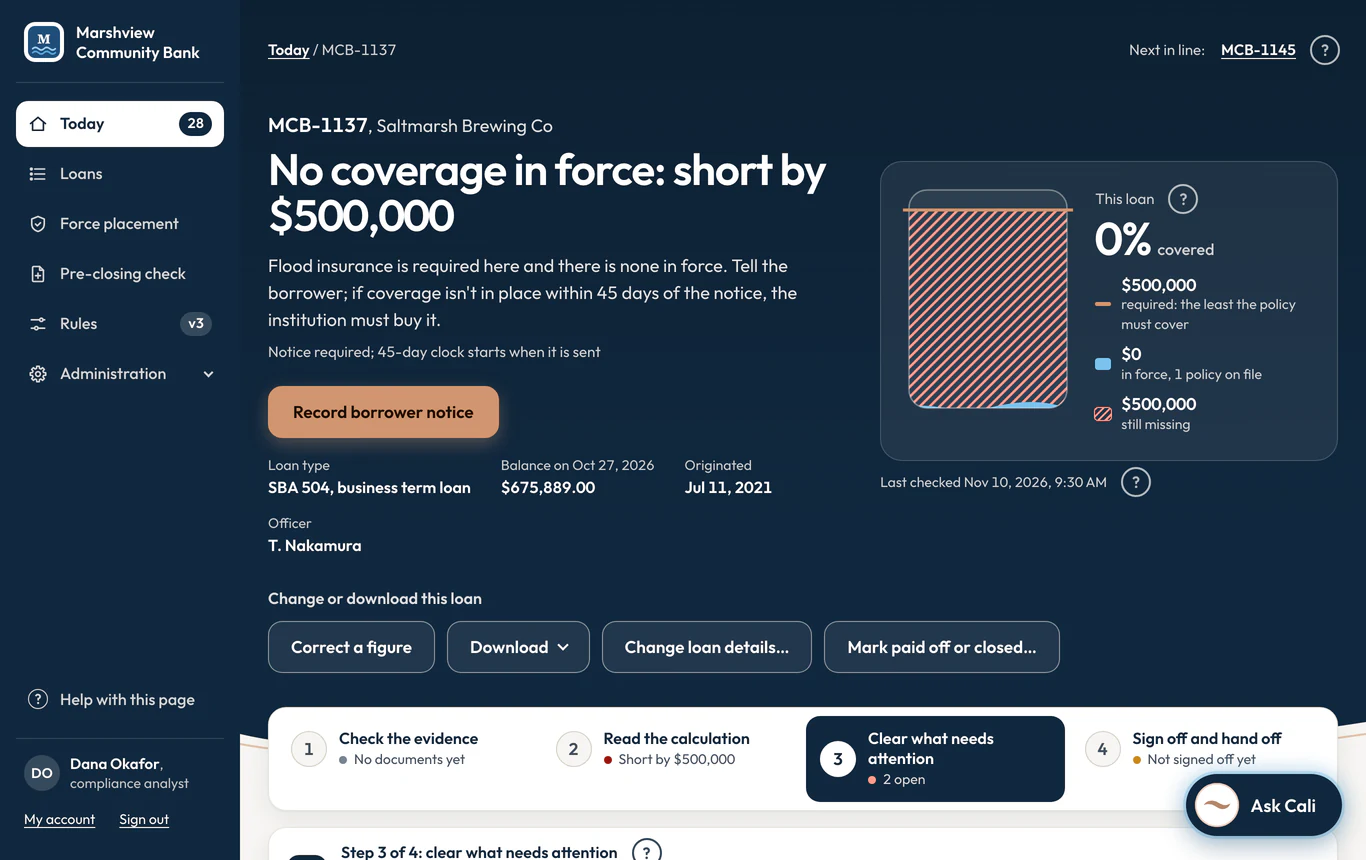
A policy check finds no flood insurance in force on the brewery’s building. The loan is short by $500,000, and it is flagged.
- FloodCaliber™Flags the loan the moment a review, a renewal or a flood map change finds a lapse or a shortfall.
- Your teamSees it at the top of the day’s work, with the reason.
Kept in the record: Nov 10, 2026, lapse found. No coverage in force, short by $500,000.
Step 2 of 5 · Nov 10, 2026, day 0
The notice starts the 45 days
The borrower is told by mail what to buy and by when: coverage is due by Dec 25, 2026.
- FloodCaliber™Works out the amount building by building, $500,000 for the brewery’s one building, and prepares the notice with it.
- Your teamSends the notice and confirms the date it went out.
Kept in the record: Nov 10, 2026, notice sent by mail. Coverage due Dec 25, 2026.
Step 3 of 5 · Dec 10, 2026, day 30
The days are counted, and proof is checked
Fifteen days are left, and nothing has come in from the borrower yet.
- FloodCaliber™Shows the days left on your board, and reads any policy the borrower sends, checking it against the $500,000 required.
- Your teamFollows up with the borrower as the date nears.
Kept in the record: Dec 10, 2026, day 30. No proof received, 15 days left.
Step 4 of 5 · Dec 26, 2026, after day 45
No proof in 45 days: the right amount is placed
The 45 days have run out with no proof, so the bank must buy the coverage: $500,000 on the brewery’s building, the amount the loan needs.
- FloodCaliber™Has the case ready: the amount for each building, the notice date and the evidence. It doesn’t buy or issue insurance.
- Your teamHas your tracking system or insurer place the policy, through a connection you approve.
Kept in the record: Dec 26, 2026, case sent to your tracking system to place $500,000.
Step 5 of 5 · Jan 8, 2027
The borrower proves coverage: the overlap is refunded
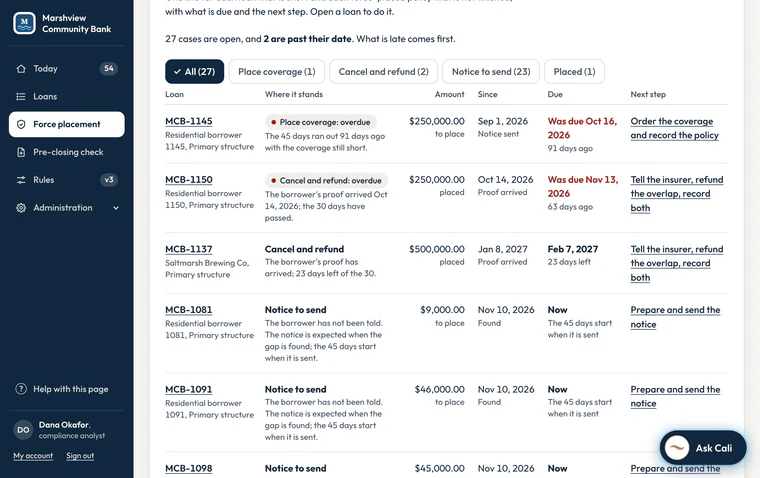
The brewery sends proof of its own $500,000 policy. The placed policy is cancelled, and the overlap is refunded by Feb 7, 2027, within 30 days of the proof.
- FloodCaliber™Reads the new policy, checks it covers the $500,000 and flags the overlap with its refund date.
- Your teamCancels the placed policy and refunds the overlap.
Kept in the record: Jan 8, 2027, borrower’s policy checked, $500,000 in force. Refund of the overlap due Feb 7, 2027.
Every date, amount and approval is kept for your examiners, in the workbook, the report and the audit record.
What changes for your team?
At most lenders these dates live in spreadsheets and a tracker’s queue, and a missed notice or a late placement breaks the rules. You keep your tracker, and give it the right amount.
Time saved
Open cases, days remaining and expiring policies sit on one board, not in a spreadsheet of dates chased by hand.
More compliant
The same steps on every loan, with the record your examiners ask for. They check the dates as well as the amounts.
The right amount
Sized building by building, so the loan isn’t left short and the borrower doesn’t pay for coverage they didn’t need.
Questions about force placement
More answers on the FAQ page.
Does FloodCaliber™ buy the insurance?
No. FloodCaliber™ doesn’t sell, buy or issue insurance. It works out the exact amount to place, prepares the notice, tracks the deadline and keeps the evidence. Your tracking system or insurer places the policy; the amount for each building and the evidence reach it through a connection your team approves.
What starts a force-placement case?
A policy that lapses, isn’t renewed or renews for too little, a shortfall found in a review, or a flood-zone change that brings a building into a special flood hazard area. At a loan increase, extension or renewal, the required coverage has to be in place before closing. The federal rules, step by step, are in our force-placement guide, and map changes in what to do when a building is remapped.
How is the amount to place worked out?
For each building and its contents: the lesser of the insurable value and the NFIP maximum, with the total capped at the outstanding principal. Each value links to its page. More in how several buildings work.
What do the federal flood rules require?
- Find the gap. A building that secures the loan has no flood insurance, or less than the loan requires.
- Notify the borrower. The lender tells the borrower to buy the required coverage.
- Wait 45 days. If the borrower hasn’t bought it within 45 days, the lender must buy it for them.
- Refund the overlap. Once the borrower proves coverage, the lender cancels the placed policy and refunds the overlap within 30 days.
Reg H · 12 CFR 208.25, 12 CFR Parts 22, 339 and 760, and the Interagency Questions and Answers.
Does it handle private flood policies?
Yes. A borrower’s new policy, NFIP or private, is read and checked against the required amount, with every value linked to its page for your acceptance review.
Does it work for commercial loans with several buildings?
Yes. The required amount and the gap are worked for each building and, where they secure the loan, its contents. That’s where placing the right amount by hand is hardest.
What about loans already on our books?
Our historical calculation audit re-checks past calculations across the portfolios you choose and lists what needs follow-up. More in the historical audit.
Who sees the borrower’s documents?
Only the people your bank allows. FloodCaliber™ runs inside your environment, and every read, change and approval is logged.
Try it yourself: the force placement tour
The tour follows one lapsed flood policy, at the fictional Saltmarsh Brewing Co, from the notice to the refund: 9 steps, about two minutes, nothing to fill in. Illustrative screens, fictional data.