
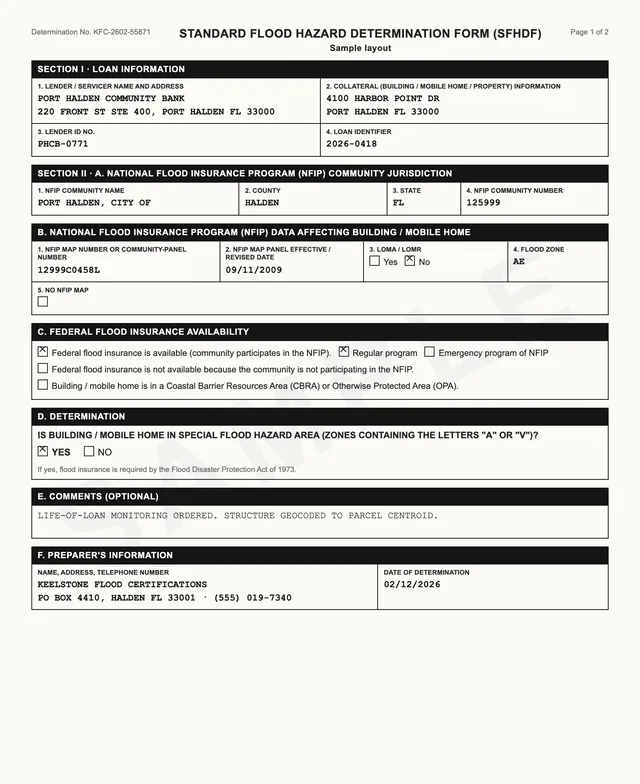
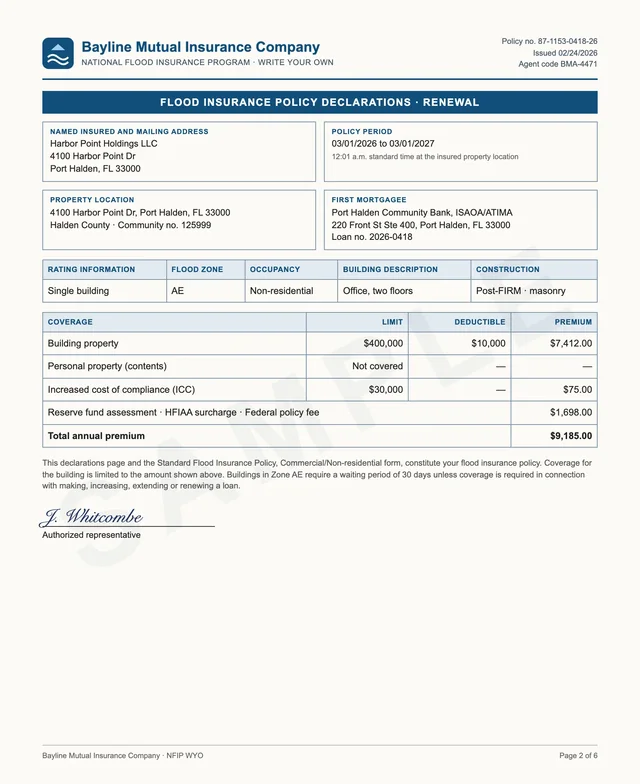
The agencies’ answer
If a flood insurance policy issued by a private insurer includes the compliance aid statement, the lender may choose to rely upon the statement and would not need to review the policy further to determine if the policy meets the definition of “private flood insurance.”
However, the lender is not required to accept this policy based upon inclusion of the compliance aid statement alone and may choose to make its own determination about whether the policy meets the definition of “private flood insurance” or whether the policy is acceptable under the discretionary acceptance or mutual aid criteria.40
If a flood insurance policy issued by a private insurer does not include the compliance aid statement, the lender may not reject the policy solely because it does not include this statement. The lender is not relieved from the requirement to accept a policy that meets the definition of “private flood insurance,” as long as the policy meets the amount of insurance required under the Regulation.41 Further, the lender may determine the policy is acceptable under the discretionary acceptance or mutual aid criteria.
Footnotes
- See 12 CFR 22.3(c) (OCC); 12 CFR 208.25(c)(3) (Board); 12 CFR 339.3(c) (FDIC); 12 CFR 614.4930(c) (FCA); and 12 CFR 760.3(c) (NCUA).
- 12 CFR 22.3(c)(1) (OCC); 12 CFR 208.25(c)(3)(i) (Board); 12 CFR 339.3(c)(1) (FDIC); 12 CFR 614.4930(c)(1) (FCA); and 12 CFR 760.3(c)(1) (NCUA).
Source
- Interagency Questions and Answers Regarding Flood Insurance, 87 FR 32826 (May 31, 2022), Federal Register. Published by the OCC, the Federal Reserve, the FDIC, the Farm Credit Administration and the NCUA.
- Mandatory 4 on the Federal Reserve’s page for the Q&As.
Text retrieved October 29, 2026.